1031 Exchange Timeline: Preserving Equity Across Deadlines
Anúncios
The 1031 exchange timeline is built around strict federal deadlines that can allow qualifying real estate investors to defer recognition of gain when exchanging investment or business real property.
For a typical deferred exchange, replacement property must be identified within 45 days and received within the applicable exchange period, subject to the federal tax-return deadline rule.
Understanding qualified intermediaries, identification rules, boot, liabilities and reporting requirements is essential because missing one requirement can turn an intended exchange into a taxable transaction.
What Is a 1031 Exchange?
Section 1031 of the Internal Revenue Code allows qualifying exchanges of real property held for investment or productive use in a trade or business.
The provision generally postpones recognition of gain rather than permanently eliminating tax, because deferred gain is reflected in the tax basis of replacement property.
Anúncios
Current federal rules primarily restrict Section 1031 treatment to qualifying real property rather than the broader range of personal property previously eligible under older law.
Tax Deferral Is Not the Same as Tax Elimination
A properly structured exchange can postpone recognition of gain that otherwise could become taxable when appreciated investment property is sold.
The unrecognized gain usually affects the basis of the replacement property, which can influence gain recognized when that property is eventually disposed of.
Anúncios
An investor may continue using qualifying exchanges later, but every transaction must independently satisfy the applicable Section 1031 rules.
The Property Must Be Held for the Right Purpose
Both relinquished and replacement real property generally must be held for investment or productive use in a trade or business.
A personal residence held primarily for personal use does not automatically qualify merely because it is real estate.
Likewise, property acquired primarily for immediate resale can create questions about whether the required investment or business-use intent exists.
Like-Kind Is Broader Than Many Investors Expect
For U.S. real property, like-kind generally refers to the nature or character of the property rather than requiring two properties to have identical uses.
Improved real estate can potentially be exchanged for unimproved land, while one type of investment property may qualify when exchanged for another type.
The key question is whether each property qualifies as real property held for the appropriate investment or business purpose under federal rules.
Location Can Matter
Real property located in the United States is not generally treated as like-kind to real property located outside the United States.
Investors considering international property should therefore not assume that the broad domestic definition of like-kind applies across national borders.
Cross-border situations deserve tax advice before the relinquished property is sold because the exchange structure must be established before funds become available to the taxpayer.
The 1031 Exchange Timeline Starts With the Sale
In a standard deferred exchange, the key identification and receipt periods begin when the relinquished property is transferred.
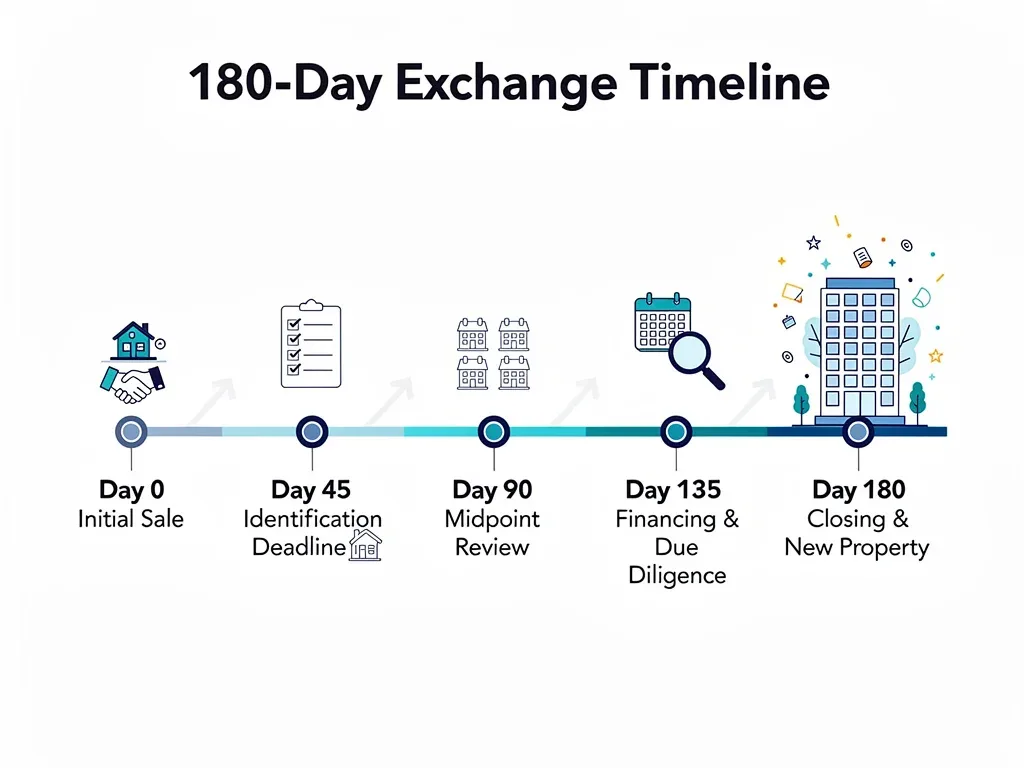
This date starts the 45-day identification period and the longer exchange period at the same time rather than creating two consecutive windows.
That means an investor does not receive an additional 180 days after the 45-day identification period ends.
Day 45 and Day 180 Run Concurrently
If the relinquished property closes on Day 0, the investor has 45 days from that transfer to satisfy the federal replacement-property identification requirement.
The exchange period also starts from that same transfer, making Day 180 the outside statutory reference point rather than 45 plus another 180 days.
Planning replacement-property searches before the original closing can therefore reduce the pressure created by these overlapping deadlines.
The 45-Day Identification Rule
Replacement property in a deferred exchange generally must be identified within 45 days after the investor transfers the relinquished property.
The identification must satisfy federal requirements and normally must describe the replacement property with sufficient clarity for it to be unmistakably identified.
Once the 45-day identification period closes, investors generally cannot simply substitute an entirely different property because their preferred deal later falls apart.

The Three-Property Rule
One commonly used identification method permits an exchanger to identify up to three replacement properties without regard to their total fair market value.
The investor does not necessarily have to acquire all three; the additional properties can provide alternatives if the preferred transaction does not close.
Careful backup planning can therefore reduce execution risk without forcing an investor to identify an excessive number of potential acquisitions.
The 200% Rule
Another identification method can allow more than three properties when their combined fair market value does not exceed the applicable 200% threshold.
This method may be useful when an investor intends to replace one large asset with several smaller qualifying real properties.
Because valuation becomes central to compliance, investors should document reasonable fair market values rather than treating the threshold casually.
The 95% Rule
A third rule can preserve an identification containing properties beyond the normal numerical or value limits when the investor acquires enough of the identified value.
The requirement is demanding because the taxpayer generally must receive qualifying identified property representing at least 95% of the total identified fair market value.
This makes the rule less forgiving than the three-property approach and unsuitable as a casual fallback for overly broad identification lists.
The Exchange Period Can End Before Day 180
The replacement property must be received by the earlier of the 180th day after transfer of the relinquished property or the federal return due date, including extensions.
This is an important qualification because an investor completing a late-year sale can encounter a tax-return deadline before the full 180 days have elapsed.
Requesting a valid filing extension can sometimes preserve the full exchange period, but tax-return planning should be coordinated with the exchange before deadlines arrive.
The Tax Return Rule Is Easy to Miss
Investors often hear that a 1031 exchange provides 180 days and assume the entire period is automatically available in every transaction.
IRS rules instead compare Day 180 with the due date of the return for the year in which the relinquished property was transferred.
Taxpayers approaching that filing deadline should discuss whether an extension is appropriate with a qualified tax professional.
The Replacement Property Must Match the Identification
Receiving a property within the exchange period is not enough if it does not satisfy the earlier identification requirements.
The IRS generally requires the taxpayer to receive substantially the same property that was properly identified during the 45-day period.
Material changes can therefore create compliance problems when the property ultimately acquired differs significantly from what was identified.
Construction Exchanges Require Additional Planning
A replacement property may sometimes be under construction or improvement when it is identified, but specialized rules govern whether it remains substantially the same property.
Only qualifying property actually received within the applicable exchange period can support the deferred exchange treatment.
Investors planning improvement exchanges should use experienced tax, legal and exchange professionals because ordinary delayed-exchange procedures may be insufficient.
Why a Qualified Intermediary Is Commonly Used
A central deferred-exchange problem is preventing the taxpayer from having actual or constructive receipt of the proceeds from the relinquished property's sale.
Federal regulations provide safe-harbor arrangements, including qualified intermediaries, qualified escrow accounts and qualified trusts under specified conditions.
In most conventional delayed 1031 transactions, a qualified intermediary is the practical mechanism used to structure the exchange and restrict the taxpayer's access to proceeds.
The QI Does More Than Hold Cash
A qualified intermediary enters into a written exchange agreement and participates in the transfer of relinquished and replacement property under federal safe-harbor rules.
The written arrangement restricts the taxpayer's rights to receive, pledge, borrow or otherwise obtain the benefits of money held during the exchange.
The QI commonly coordinates assignments, notices, documentation and funds as part of carrying out the transaction under the exchange agreement.
Not Everyone Can Serve as Your QI
Federal rules exclude certain disqualified persons from serving as qualified intermediaries in a safe-harbor deferred exchange.
Someone who recently acted as the taxpayer's attorney, accountant, real estate broker or certain other agents may fall within those restrictions.
Investors should therefore select the exchange facilitator before closing instead of assuming any trusted professional can automatically fill the role.
Choose the QI Before the Relinquished Property Closes
A deferred exchange should be structured before the taxpayer receives unrestricted access to the sale proceeds.
Waiting until money has already been paid directly to the investor can eliminate the safe-harbor structure the transaction needed to qualify.
The exchange agreement, assignments and closing instructions should therefore be coordinated before the relinquished-property transfer occurs.
Evaluate How Exchange Funds Are Protected
Tax compliance is not the only consideration because a QI may temporarily control a substantial amount of the investor's money.
Investors should understand where funds are held, who can authorize transfers and what safeguards the intermediary uses against fraud or financial failure.
Insurance, bonding, account controls and institutional experience can be useful due-diligence considerations even though tax qualification depends on federal rules rather than marketing credentials.
What Does Full Tax Deferral Actually Require?
Full deferral requires more than simply checking whether the replacement property has a purchase price equal to or greater than the relinquished property's price.
The taxpayer must avoid receiving taxable money or non-like-kind property after considering the transaction's exchange expenses and treatment of liabilities.
Because gain recognition depends on several variables, investors should not rely solely on a simple purchase-price or mortgage comparison.
The Equal-or-Greater Rule Is a Planning Shortcut
Industry guidance often recommends purchasing replacement real estate of equal or greater value and reinvesting all available exchange proceeds.
This can be a useful practical planning framework, but it is not a complete statement of the federal tax calculation.
The actual recognized gain depends on realized gain, money and non-like-kind property received, liabilities, exchange costs and other transaction-specific factors.
Debt Does Not Need to Match Dollar for Dollar in Every Case
Debt relief can be treated as money received, but liabilities assumed and additional cash contributed can affect the resulting recognized-gain calculation.
Therefore, reducing mortgage debt does not automatically produce taxable gain equal to the entire reduction without considering the rest of the exchange.
A CPA or tax attorney should model the complete transaction when financing changes materially between the relinquished and replacement properties.
Understanding Boot in a 1031 Exchange
Boot is an industry term commonly used for money or non-like-kind property received in connection with an otherwise qualifying exchange.
If an investor realizes a gain and receives money or other non-like-kind property, some of that gain may become immediately recognizable for federal tax purposes.
The taxable amount is not automatically the total boot received because federal rules limit recognized gain according to the underlying realized-gain calculation.
Cash Boot
Cash distributed to the taxpayer from the exchange can create recognized gain instead of remaining entirely sheltered within the like-kind exchange.
This can occur when not all exchange proceeds are required for acquisition or when money becomes available to the taxpayer under the exchange agreement.
Planning should therefore determine in advance whether the investor prioritizes maximum deferral or intentionally accepts some current taxable gain.
Liability Relief Can Affect Recognized Gain
If another party assumes liabilities associated with the relinquished property, federal rules can treat that relief as money received for exchange calculations.
However, liabilities assumed by the taxpayer and certain cash paid can offset some of that amount when recognized gain is determined.
This net treatment is why a simplistic rule stating that replacement debt must always equal old debt can produce misleading advice.
A Better Example of Full Deferral
Suppose an investor sells qualifying investment real estate and places all exchange proceeds under a properly structured qualified-intermediary arrangement.
The investor then acquires properly identified like-kind real property within the exchange period without receiving cash or other taxable non-like-kind consideration.
If the transaction otherwise satisfies Section 1031 and no gain must be recognized under the applicable boot and liability rules, the realized gain can be deferred.
Do Not Focus Only on Equity
“Preserving equity” can be a useful investment objective, but equity itself is not the statutory test that determines how much gain receives nonrecognition treatment.
Tax basis, liabilities, exchange expenses, fair market value and consideration received all affect the federal tax result.
An investor can therefore make an economically reasonable acquisition yet still recognize some gain if the transaction is structured incorrectly.
Financing Can Become the Biggest Timing Risk
Once property is identified, the investor still must complete underwriting, appraisal, inspection, title review and closing within the exchange period.
A financing delay does not ordinarily suspend the federal deadline merely because the lender needs additional documentation or underwriting time.
Early lender coordination is therefore important when replacement property will require significant debt financing.
Prequalification Does Not Guarantee Closing
A preliminary lender review can improve preparation but still leaves appraisal, title, borrower documentation and property-specific underwriting to complete.
Investors should communicate the exchange deadline clearly so every transaction participant understands that an ordinary closing delay may create tax consequences.
Backup financing or additional identified properties can sometimes provide flexibility, but each alternative must still comply with the identification rules.
Due Diligence Still Matters Under Time Pressure
The 45-day deadline can create pressure to acquire a property quickly, but tax deferral should not replace ordinary real estate investment analysis.
Physical condition, leases, zoning, title, environmental issues, insurance costs and expected cash flow can matter more economically than the immediate tax benefit.
A weak investment does not become attractive simply because purchasing it allows an investor to complete an exchange.
Start Searching Before the Sale
One practical strategy is to begin reviewing potential replacement properties before the relinquished property's closing date starts the formal identification clock.
This can provide additional time for market analysis, lender conversations and preliminary due diligence before identification becomes irrevocably constrained.
Planning early can therefore improve both tax execution and investment quality without changing the federal deadlines themselves.
Reverse Exchanges Follow Different Mechanics
A reverse exchange addresses the situation where replacement property is acquired before the relinquished property has been transferred.
Ordinary deferred-exchange rules do not automatically solve this sequence because the investor already owns the new property before disposing of the old one.
Federal guidance provides a safe-harbor structure using a Qualified Exchange Accommodation Arrangement when specified requirements are satisfied.
An EAT Can Hold the Property
Under a qualifying arrangement, an Exchange Accommodation Titleholder can hold qualified indicia of ownership in the relevant property during the reverse-exchange process.
The structure follows specialized timing and documentation requirements that differ from a standard sale-first deferred exchange.
Because additional entities and financing issues are involved, reverse exchanges generally require more preparation than ordinary delayed exchanges.
Improvement Exchanges Also Need Specialized Structuring
Some investors want exchange proceeds to fund construction or improvements rather than simply purchase an already completed replacement property.
That objective can require property to be held within a specialized exchange accommodation arrangement while improvements are completed.
The taxpayer generally cannot simply acquire property personally and continue spending exchange funds on improvements after receiving the property.
Only Timely Received Property Counts
The replacement property ultimately received must satisfy applicable like-kind and timing requirements for the exchange treatment being claimed.
Improvements completed after the property has already been transferred to the taxpayer do not automatically become part of the earlier exchange value.
Investors contemplating major construction should involve exchange and tax professionals before acquiring or parking the replacement property.
Partnership Interests Usually Do Not Qualify
Federal law generally excludes exchanges of partnership interests from the Section 1031 like-kind nonrecognition rules.
This creates complications when multiple owners hold real estate through a partnership but individual partners want different outcomes after a sale.
Changing ownership structure immediately before an exchange can create additional tax and substance questions that deserve specialized advice.
Entity Structure Matters Before the Sale
The taxpayer who transfers the relinquished property generally needs to be appropriately connected to the acquisition of the replacement property within the exchange structure.
LLCs, partnerships, disregarded entities and trusts can therefore create different planning considerations depending on their federal tax classification.
Ownership changes should not be implemented solely from an online checklist when a large deferred gain is at stake.
Related-Party Exchanges Have Additional Rules
Transactions involving related parties receive additional scrutiny because Section 1031 contains special rules designed to prevent certain tax-avoidance structures.
A QI does not automatically eliminate those restrictions merely because the related party is separated from the taxpayer by an intermediary.
IRS Form 8824 specifically asks for information about certain direct and indirect related-party exchanges.
Subsequent Dispositions Can Matter
Related-party rules can affect the exchange when property is disposed of too soon after the transaction or when a structure effectively cashes out a related party.
Exceptions exist for particular circumstances, but the analysis can become highly fact specific.
Investors contemplating a related-party acquisition should obtain tax advice before signing contracts rather than discovering the restriction after closing.
The Replacement Property Takes a Carryover-Style Basis
One reason Section 1031 normally defers rather than erases gain is that the replacement property's tax basis incorporates the economics of the previous property.
In a straightforward fully deferred exchange, the basis of the new real estate is generally linked to the basis of the relinquished property with required adjustments.
This lower basis can affect future depreciation deductions and the amount of gain recognized in a later taxable sale.
Basis Calculations Can Become Complex
Cash paid, recognized gain, exchange expenses, liabilities and non-like-kind property can all affect basis calculations in a partially taxable exchange.
Depreciation history can introduce additional federal tax issues when the relinquished property has been used in a rental or business activity.
Accurate closing statements and historical depreciation records should therefore be retained with the exchange documentation.
Form 8824 Reports the Exchange
Taxpayers generally report a qualifying like-kind exchange on IRS Form 8824 for the year in which the exchange occurs.
The form records identifying dates, values, basis information, liabilities and calculations needed to determine recognized and deferred gain.
Even when no gain is currently recognized, the transaction still needs to be properly reported rather than omitted from the federal return.
Keep the Identification Records
Exchange files should preserve the written replacement-property identification, QI agreement, assignments, closing statements and evidence of acquisition dates.
These documents help establish that the taxpayer complied with the 45-day and exchange-period requirements shown on Form 8824.
Records should also support basis and deferred-gain calculations needed in future tax years when the replacement property is sold or exchanged again.
Disaster Relief Can Modify Normal Deadlines
The standard 45-day and exchange-period deadlines are strict, but federal disaster-relief procedures can sometimes postpone tax deadlines for qualifying affected taxpayers.
Any relief depends on an official federal announcement and the particular rules applicable to the disaster area and transaction.
Investors should never assume that a hurricane, wildfire or other local emergency automatically extends a 1031 deadline without confirming applicable IRS relief.
Weekends Normally Do Not Create Automatic Extensions
The identification and exchange periods are measured in calendar days, so ordinary weekends do not automatically provide additional time.
This is different from some tax filing deadlines that move when a statutory due date falls on a weekend or legal holiday.
Exchange participants should therefore calculate dates at closing and place multiple reminders well before the final permissible day.
A 1031 Exchange Should Be Planned Before Closing
The most preventable exchange failures occur when an investor begins researching Section 1031 only after the relinquished property's sale has already closed.
At that point, receiving or controlling the proceeds may already have destroyed the intended deferred-exchange structure.
Tax, legal, financing and intermediary planning should begin while the property is still being marketed or under contract whenever possible.
Build a Professional Team Early
A qualified intermediary facilitates the exchange mechanics, while a CPA or tax attorney should analyze federal and state tax consequences.
Real estate brokers, lenders, title professionals and attorneys may also need to understand the timing requirements affecting their portion of the transaction.
No single participant should be assumed to provide every type of legal, tax, financial and investment advice required by a complex exchange.
1031 Exchange Timeline at a Glance
The 1031 exchange timeline begins with transfer of the relinquished property and immediately starts both the identification and exchange periods.
Replacement property must generally be identified within 45 days and acquired by the earlier applicable exchange-period deadline.
Successful deferral also requires qualifying property, proper control of proceeds and correct treatment of money, liabilities and non-like-kind property.
Key Timeline Checkpoints
Before closing, establish the exchange structure and safe-harbor arrangement; after closing, complete replacement-property identification before the 45-day period expires.
Then perform due diligence, arrange financing and receive qualifying identified property before the applicable exchange period ends.
Finally, retain all exchange records and report the transaction accurately on Form 8824 with the federal tax return.
Exchange Stage | Federal Rule |
|---|---|
Before Sale | Establish the exchange structure before receiving unrestricted sale proceeds. |
Identification Period | Identify replacement property within 45 days after transferring the relinquished property. |
Exchange Period | Receive replacement property by Day 180 or the federal return due date, including extensions, whichever is earlier. |
Qualified Intermediary | Common safe harbor used to avoid actual or constructive receipt in a deferred exchange. |
Tax Reporting | Report the exchange on Form 8824 and retain supporting documentation. |
Frequently Asked Questions About 1031 Exchanges
What is the 45-day rule in a 1031 exchange?
Replacement property generally must be properly identified within 45 days after the relinquished property is transferred.
Do I get 180 days after the 45-day period?
No. Both periods begin when the relinquished property is transferred, so the 180-day period runs concurrently with the 45-day identification period.
Is the 180-day deadline always available in full?
No. Replacement property must be received by the earlier of Day 180 or the due date of the federal return for that tax year, including extensions.
Can weekends extend the 45-day deadline?
Ordinary weekends do not automatically extend the identification period. Special federally announced disaster relief can apply in qualifying circumstances.
Is a Qualified Intermediary legally required in every 1031 exchange?
No. A QI is a commonly used federal safe harbor for deferred exchanges, but federal rules recognize other qualifying structures in certain circumstances.
Can I receive the sale proceeds and then give them to a QI?
Generally, actual or constructive receipt before the exchange is properly structured can cause the transaction to be treated as a taxable sale.
Must my replacement mortgage equal or exceed the old mortgage?
Not as a standalone rule. Liabilities affect the boot calculation, but cash paid and liabilities assumed can offset liability relief under federal rules.
What is boot?
Boot commonly refers to money or non-like-kind property received in an exchange that may cause some realized gain to become taxable.
Can I exchange an apartment building for vacant land?
Potentially yes. U.S. real property can be like-kind despite differences in grade, quality or specific use when the other requirements are satisfied.
How is a 1031 exchange reported to the IRS?
Qualifying exchanges are generally reported on Form 8824 for the tax year in which the exchange occurs.
Conclusion
The 1031 exchange timeline requires much more than remembering two numbers: the 45-day identification period and the applicable exchange period must be coordinated from the original closing date.
Full tax deferral depends on qualifying real property, proper handling of sale proceeds and correct treatment of cash, liabilities, boot and basis rather than a simple value-and-debt formula.
Because one missed deadline or structural error can create immediate tax consequences, investors should involve an experienced QI and qualified tax professionals before transferring the relinquished property.