Navigating 2026 Corporate AMT: Key Financial Impacts for Shareholders
Anúncios
The 2026 Corporate Alternative Minimum Tax affects eligible large corporations through a 15% minimum tax framework, introducing important considerations for corporate earnings, dividend distributions, investment valuations, and shareholder financial planning.
The 2026 Corporate Alternative Minimum Tax presents important financial considerations for shareholders evaluating corporate profitability, dividend distributions, investment valuations, and long-term financial planning strategies.
Understanding how this federal tax framework operates can help investors assess potential changes in corporate expenses, available cash flow, and future financial performance.
This guide explains applicable corporate thresholds, accounting requirements, tax credit limitations, and practical considerations for private shareholders navigating the evolving American tax environment.
Understanding the 2026 Corporate Alternative Minimum Tax Framework
The 2026 Corporate Alternative Minimum Tax operates under provisions established by the Inflation Reduction Act of 2022, targeting certain corporations with substantial financial statement income.
Anúncios
The legislation introduced a 15% minimum tax framework based on adjusted financial statement income, commonly abbreviated as AFSI, subject to applicable adjustments and credits.
Although the tax became effective for taxable years beginning after December 31, 2022, subsequent regulatory guidance continues to influence corporate compliance and financial planning.
How the Corporate Minimum Tax Works
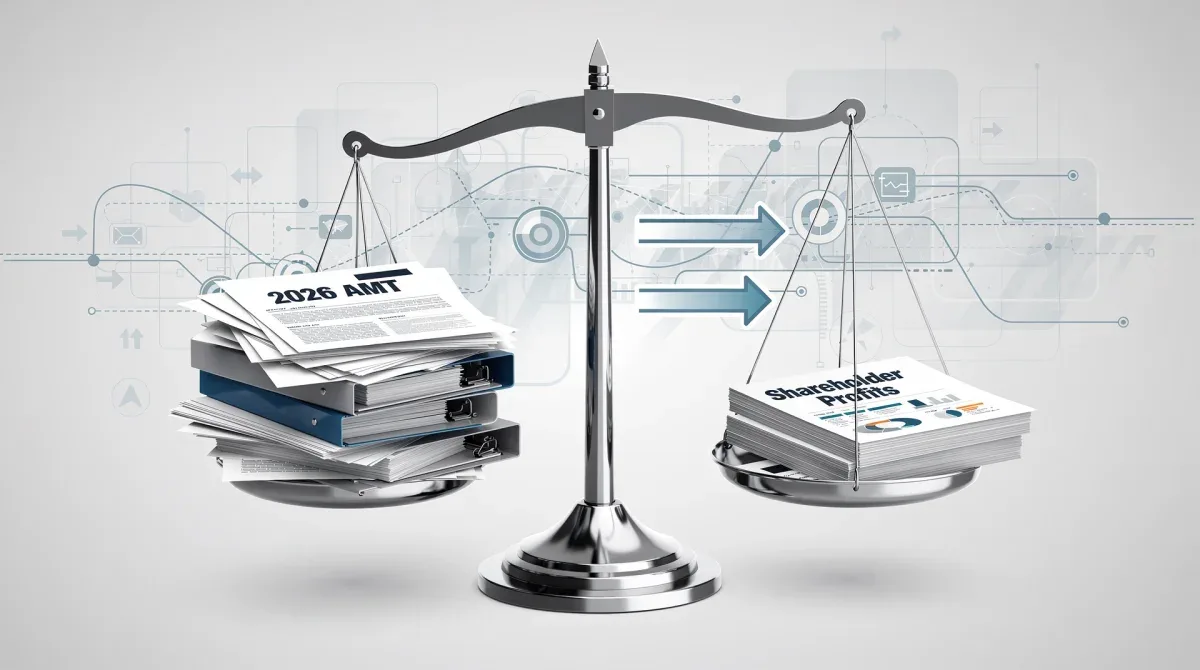
Applicable corporations calculate their tentative minimum tax using adjusted financial statement income and compare the resulting amount with their regular corporate tax obligations.
Anúncios
The 2026 Corporate Alternative Minimum Tax may generate additional liabilities when tentative minimum tax exceeds the applicable combination of regular tax and base erosion tax.
This calculation means that eligible corporations do not automatically pay an additional 15% on top of their existing federal corporate income tax obligations.
Understanding Adjusted Financial Statement Income
Adjusted financial statement income generally begins with income or loss reported on applicable corporate financial statements before incorporating adjustments required under federal tax legislation.
These adjustments may involve depreciation, financial statement losses, partnership interests, international operations, and other items receiving different treatment under financial accounting and federal taxation.
Shareholders should understand that reported accounting profits, taxable income, and adjusted financial statement income represent different measurements that can produce substantially different financial results.
Defining Applicable Corporations and Exemptions
The 2026 Corporate Alternative Minimum Tax primarily applies to large corporations meeting specific financial statement income requirements established under the Internal Revenue Code.
Privately held corporations can potentially become subject to this framework, although privately owned businesses are not automatically affected simply because they generate substantial revenue.
S corporations, regulated investment companies, and real estate investment trusts are generally excluded from the statutory definition of applicable corporations under these minimum tax provisions.
The $1 Billion AFSI Threshold Explained
The general eligibility test considers whether a corporation's average annual adjusted financial statement income exceeds $1 billion during the applicable three-tax-year measurement period.
Specific aggregation rules may require corporations to consider income associated with related entities when determining whether their operations satisfy the statutory financial statement income threshold.
Consequently, evaluating exposure to the 2026 Corporate Alternative Minimum Tax requires more than reviewing the annual revenue or reported profits of an individual business.
Special Rules for Foreign-Parented Multinational Groups
Corporations belonging to foreign-parented multinational groups must evaluate additional financial statement income tests when determining whether the corporate minimum tax provisions apply to their operations.
These rules generally combine a group-level $1 billion income test with a separate $100 million test calculated under the applicable statutory requirements.
Both tests must be considered together, rather than interpreting the $100 million threshold as an independent replacement for the broader multinational group income requirement.
Understanding Simplified Eligibility Tests
IRS interim guidance introduced an optional simplified approach that may help qualifying businesses determine whether they are considered applicable corporations for minimum tax purposes.
This method uses reduced screening thresholds of $800 million and $80 million in place of the corresponding statutory thresholds when applicable conditions are satisfied.
These amounts function as simplified screening criteria rather than permanent replacements for the underlying statutory requirements governing the 2026 Corporate Alternative Minimum Tax.
Direct Financial Impacts on Corporate Earnings
Additional corporate tax liabilities can reduce after-tax earnings and influence the amount of financial resources available for business expansion, operational activities, and shareholder distributions.
The financial impact of the 2026 Corporate Alternative Minimum Tax depends on individual corporate circumstances, existing tax liabilities, available credits, and financial statement adjustments.
Businesses with sufficiently high regular tax obligations may experience limited additional liability, while other applicable corporations could encounter more significant changes in cash flow.
Impact on Dividend Distributions and Shareholder Returns
When additional tax expenses reduce available corporate cash, management may reconsider dividend distributions, capital investment programs, debt repayments, or other planned uses of financial resources.
Private shareholders could experience changes in dividend income, although the actual outcome depends on corporate financial performance, distribution policies, and decisions made by company management.
The 2026 Corporate Alternative Minimum Tax does not automatically require corporations to reduce dividend payments or alter their existing commitments to shareholders.
Effects on Retained Earnings and Reinvestment
Retained earnings provide businesses with resources that can support future investments, operating expenses, acquisitions, and other activities intended to strengthen their long-term financial position.
Additional tax obligations may influence the balance between distributing profits to shareholders and maintaining sufficient financial resources to support existing operations and future business development.
Investors should examine corporate financial reports to understand whether changes in retained earnings result from taxation, operating performance, financing decisions, or other economic factors.
Indirect Effects on Investment Strategies and Valuations
The 2026 Corporate Alternative Minimum Tax may influence how investors evaluate corporate financial performance, particularly when additional tax expenses affect expected future cash flows.
Private shareholders reviewing their investment strategies should consider tax exposure alongside business profitability, market conditions, financial stability, and the long-term growth prospects of individual companies.
Changes in corporate tax obligations represent one component of investment analysis rather than an independent indicator that a company's valuation will necessarily decline.
How Corporate Taxation Can Influence Equity Valuations
Company valuations frequently reflect expectations concerning future earnings, operating cash flows, financial risks, and the potential returns associated with ownership of corporate equity.
When additional tax liabilities affect these expectations, investors may adjust their financial projections and reconsider assumptions used to estimate the value of their holdings.
However, market valuations also respond to interest rates, competitive conditions, management decisions, and broader economic developments that may outweigh the effects of corporate taxation.
Differences Between Public and Private Shareholders
Publicly traded corporations generally provide regular financial disclosures that investors can review when evaluating corporate tax expenses, effective tax rates, and overall financial performance.
Shareholders in privately held corporations may depend on internal financial statements, management reports, and information provided through established shareholder agreements or authorized communication channels.
Understanding the 2026 Corporate Alternative Minimum Tax can therefore require different approaches depending on the financial information available and the ownership structure involved.
Accounting and Reporting Challenges for Businesses
Applicable corporations must evaluate regular federal income tax obligations alongside minimum tax calculations, introducing additional accounting responsibilities and requirements for accurate financial information management.
The 2026 Corporate Alternative Minimum Tax can involve complex reconciliations between financial statement income and statutory tax calculations, requiring appropriate documentation and internal controls.
These responsibilities may increase administrative expenses, although the financial significance of compliance costs depends on existing corporate accounting systems and available professional expertise.
Key Accounting Adjustments and Compliance
Corporate accounting teams must identify relevant financial statement adjustments and ensure that supporting records remain consistent with the requirements established under applicable federal tax provisions.
Financial reporting may also require consideration of minimum tax credit carryforwards and their potential accounting treatment according to the financial reporting standards used.
Accurate documentation supports tax calculations, regulatory compliance, internal financial planning, and communication with shareholders interested in understanding the company's overall tax position.
Understanding Financial Statement Disclosures
Corporate financial reports may provide information about current tax expenses, effective tax rates, deferred tax balances, and uncertainties associated with specific tax positions.
Shareholders should distinguish between accounting tax expenses and actual cash tax payments because these measurements may differ significantly depending on the company's circumstances.
Reviewing relevant disclosures can help investors evaluate how the 2026 Corporate Alternative Minimum Tax interacts with other financial developments affecting corporate profitability.
Strategic Responses for Private Shareholders
Private shareholders can prepare for potential corporate tax impacts by reviewing their investment exposure, understanding corporate financial disclosures, and evaluating the circumstances surrounding individual holdings.
Diversification may help manage concentration risks, although investment allocation decisions should reflect personal financial objectives, investment horizons, liquidity requirements, and individual risk tolerance.
Consulting qualified financial and tax professionals can help shareholders distinguish corporate tax obligations from personal tax responsibilities associated with dividends and capital gains.
Monitoring Corporate Tax Exposure
Investors should consider whether companies within their portfolios meet the statutory requirements for classification as applicable corporations under the federal minimum tax framework.
However, corporate eligibility does not automatically establish an additional tax liability because actual obligations depend on detailed calculations and available statutory credits.
The 2026 Corporate Alternative Minimum Tax should therefore be evaluated using relevant company disclosures rather than assumptions based exclusively on corporate size.
Maintaining a Long-Term Investment Perspective
Investment decisions based exclusively on individual tax developments may overlook important considerations involving business competitiveness, financial stability, management quality, and future economic opportunities.
Shareholders should evaluate potential tax-related changes within their broader financial plans, considering whether those developments materially affect their established investment objectives and expectations.
Maintaining realistic assumptions and reviewing reliable financial information can support more informed decisions without reacting prematurely to uncertain regulatory developments or speculative market predictions.
The Role of Tax Credits and Their Interaction With CAMT
Tax credits represent an important consideration under the 2026 Corporate Alternative Minimum Tax because applicable provisions may influence a corporation's final federal tax obligations.
Qualifying foreign tax credits can reduce tentative minimum tax calculations, while eligible general business credits may provide additional relief subject to applicable statutory limitations.
The availability and effectiveness of individual credits depend on their legal requirements, calculation methods, ordering rules, and the corporation's specific financial and tax circumstances.
Maximizing Credit Utilization Under Minimum Tax Rules
Corporations should maintain accurate records of available tax credits and evaluate their potential application against relevant federal tax obligations under the appropriate statutory provisions.
General business credit limitations can involve complex calculations, making it inappropriate to assume that every corporation can offset an identical percentage of its minimum tax.
Professional tax modeling may help businesses understand how different credit arrangements influence corporate expenses, available cash flow, and financial planning responsibilities across multiple years.
Understanding Minimum Tax Credit Carryforwards
Corporations that incur minimum tax liabilities may qualify for credits against future regular tax obligations when applicable requirements under the Internal Revenue Code are satisfied.
These credits may provide future financial benefits, although their utilization depends on subsequent corporate tax calculations and the statutory limitations governing available credit amounts.
Shareholders evaluating the 2026 Corporate Alternative Minimum Tax should distinguish immediate cash tax payments from potential benefits associated with minimum tax credit carryforwards.
How the Corporate Minimum Tax Affects Personal Shareholder Taxes
The corporate minimum tax is imposed on applicable businesses rather than directly on individual shareholders who own shares in those corporations or associated investment portfolios.
Nevertheless, changes in corporate distributions or equity valuations may indirectly influence personal financial circumstances, depending on the investment structure and individual taxpayer's situation.
Personal taxation of dividends and capital gains continues to follow separate federal and state tax rules that should be evaluated independently of corporate minimum tax obligations.
Dividend Income and Capital Gains Considerations
Shareholders receiving corporate dividends may have personal tax reporting obligations depending on the nature of those distributions and their individual federal income tax circumstances.
Capital gains or losses generally arise when investments are sold or otherwise disposed of under applicable tax rules, rather than solely because valuations fluctuate.
Understanding these distinctions helps investors avoid incorrectly interpreting the 2026 Corporate Alternative Minimum Tax as a separate tax imposed directly on their personal investment income.
IRS Reporting Requirements and Regulatory Updates
Corporations evaluating their minimum tax obligations should consult official Internal Revenue Service guidance concerning eligibility calculations, applicable adjustments, documentation requirements, and federal filing procedures.
The IRS provides information through its official Corporate Alternative Minimum Tax guidance, including regulatory updates and resources relevant to businesses determining their obligations under this framework.
Because implementation guidance continues to develop, corporations should verify which provisions apply to their particular taxable year before relying on previously issued instructions.
Understanding Form 4626
Form 4626 helps corporations determine their applicable corporation status and calculate corporate alternative minimum tax obligations, subject to relevant filing exceptions and eligibility requirements.
Businesses completing this form must follow the applicable instructions, including requirements concerning financial statement income, qualifying adjustments, available credits, and other relevant tax calculations.
Private shareholders generally do not file this corporate form merely because they hold shares in businesses potentially subject to federal minimum tax requirements.
Important Regulatory Developments During 2026
During February 2026, the IRS published additional interim guidance addressing selected adjustments and implementation issues associated with the corporate alternative minimum tax framework.
The guidance covers areas including certain research expenditures, depreciation-related repairs, qualifying intangible assets, and specific circumstances involving financially troubled corporations and covered transactions.
These developments demonstrate why companies affected by the 2026 Corporate Alternative Minimum Tax should monitor official updates instead of relying exclusively on earlier interpretations.
Looking Ahead: Future Guidance and Adjustments
The Treasury Department and Internal Revenue Service may continue issuing guidance that clarifies technical requirements, financial statement adjustments, and compliance procedures associated with corporate minimum taxation.
Future developments could influence how applicable corporations evaluate their obligations, prepare federal tax returns, manage available credits, and communicate relevant financial information to shareholders.
Investors should distinguish confirmed regulatory requirements from proposed changes, ensuring that financial decisions reflect applicable rules rather than speculation about potential future legislation.
Preparing for Future Corporate Tax Developments
Corporate financial planning may involve evaluating different tax scenarios, monitoring regulatory developments, and identifying potential changes to investment decisions or long-term capital allocation strategies.
Shareholders can benefit from understanding how management addresses these uncertainties, particularly when tax obligations could influence corporate cash flow or planned distributions.
Monitoring official information and relevant financial disclosures remains important as businesses continue adapting their operations to the 2026 Corporate Alternative Minimum Tax framework.
What Happens Now

Applicable corporations must continue evaluating their federal tax obligations while adapting internal accounting procedures to relevant statutory requirements and additional guidance published by federal authorities.
Private shareholders should monitor meaningful changes in corporate financial performance, paying particular attention to tax expenses, dividend policies, cash flow, and investment decisions.
Qualified professional guidance can help investors interpret these developments appropriately while maintaining financial strategies aligned with their personal circumstances and long-term investment objectives.
Conclusion
The 2026 Corporate Alternative Minimum Tax remains an important consideration for eligible large corporations, with potential indirect consequences for private shareholders and investment valuations.
Its financial impact depends on corporate profitability, statutory adjustments, available credits, existing tax obligations, and management decisions concerning the allocation of financial resources.
Shareholders should prioritize reliable financial disclosures, official IRS guidance, and qualified professional advice when evaluating how these corporate tax provisions may affect their investments.
Key Impact Area | Brief Description |
|---|---|
Minimum Tax Rate | A 15% minimum tax framework based on adjusted financial statement income, subject to applicable calculations and credits. |
Corporate Eligibility | Generally applies to corporations exceeding the statutory $1 billion average annual AFSI threshold, with additional multinational group rules. |
Corporate Earnings | Additional tax liabilities may reduce after-tax earnings and influence available corporate cash flow. |
Shareholder Returns | Potential changes in dividend distributions and equity valuations, depending on individual corporate circumstances. |
Investment Strategy | Review corporate tax exposure alongside business performance, financial objectives, and existing investment risks. |
Compliance Costs | Potential administrative expenses associated with accounting adjustments, documentation, and federal tax reporting. |
Tax Credits | Qualifying foreign tax credits, general business credits, and prior-year minimum tax credits may provide relief subject to statutory limitations. |
Personal Shareholder Taxes | The corporate minimum tax does not directly impose a separate tax on individual shareholders. |
2026 Regulatory Guidance | Additional IRS interim guidance clarifies selected financial statement adjustments and implementation requirements. |
Frequently Asked Questions About the 2026 Corporate AMT
What is the core purpose of the 2026 Corporate Alternative Minimum Tax?
The Corporate Alternative Minimum Tax establishes a 15% minimum tax framework based on the adjusted financial statement income of applicable large corporations. It operates alongside regular corporate taxation and incorporates specific adjustments, credits, and statutory limitations.
Was the Corporate Alternative Minimum Tax introduced in 2026?
No. The Inflation Reduction Act of 2022 established the current corporate minimum tax framework, which became effective for taxable years beginning after December 31, 2022. Regulatory guidance and implementation developments continue during 2026.
Which corporations are subject to the minimum tax?
The tax generally applies to corporations with average annual adjusted financial statement income exceeding $1 billion during the applicable three-year measurement period. Additional eligibility rules apply to corporations belonging to foreign-parented multinational groups.
Does the Corporate Alternative Minimum Tax apply to privately held companies?
Potentially. Publicly traded and privately held corporations can fall within the framework when they satisfy applicable statutory requirements. Private ownership does not automatically establish an exemption or create a tax liability.
How will this affect private shareholder dividend income?
Additional corporate tax liabilities may reduce available cash for dividend distributions. However, actual dividend payments depend on company profitability, financial policies, management decisions, and other relevant circumstances.
Are there tax credits that can offset corporate minimum tax obligations?
Yes. Qualifying foreign tax credits and general business credits may influence corporate tax obligations, subject to specific statutory requirements. Corporations may also qualify for credits associated with minimum tax incurred during previous years.
Do individual shareholders pay the 15% corporate minimum tax directly?
No. The tax applies to eligible corporations rather than directly to individual shareholders. Personal tax obligations involving dividends, capital gains, and other investment income remain subject to separate tax rules.
What is the difference between corporate AMT and individual AMT?
The corporate minimum tax applies to qualifying large corporations based on adjusted financial statement income. Individual alternative minimum tax operates under separate rules and determines whether certain individual taxpayers owe additional federal income tax.
Does every applicable corporation automatically owe additional minimum tax?
No. Applicable corporation status establishes that the business must evaluate relevant minimum tax obligations. The actual additional liability depends on tentative minimum tax calculations, regular tax obligations, base erosion tax when applicable, and available credits.
What immediate steps should private shareholders consider?
Shareholders can review corporate financial disclosures, assess investment concentration, monitor changes in dividend policies, and consult qualified financial or tax professionals. Individual investment decisions should reflect broader financial objectives rather than corporate tax developments alone.