72(t) SEPP Distribution: Access Retirement Funds Before 59.5 Penalty-Free
Anúncios
How to Structure a 72(t) SEPP Distribution Plan is an important topic for Americans who want to access retirement savings before age 59½ without triggering the usual 10% additional early withdrawal tax. Section 72(t) provides an exception for qualifying substantially equal periodic payments, but the requirements demand careful planning.
A 72(t) SEPP distribution plan establishes a series of withdrawals calculated under specific Internal Revenue Service guidelines. These payments can provide income during early retirement, although they may remain subject to ordinary income taxes and affect future retirement savings.
Understanding eligibility, permitted calculation methods, payment schedules, and modification rules is essential before beginning distributions. Even an unintended change can create significant tax consequences.
Understanding the 72(t) SEPP Distribution Basics
Section 72(t) of the Internal Revenue Code generally imposes an additional 10% tax on taxable retirement distributions received before age 59½, unless an exception applies.
One exception allows substantially equal periodic payments, commonly called SEPPs, calculated over the account owner's life expectancy or the joint life expectancies of the owner and a designated beneficiary.
Anúncios
A properly structured 72(t) SEPP distribution plan can qualify for this exception, but the withdrawals must follow applicable IRS requirements. The exception concerns the additional early distribution tax, not necessarily the ordinary income tax owed on withdrawals.
Eligibility and Account Types for 72(t) Plans

A 72(t) SEPP distribution plan may be established using eligible retirement arrangements, including traditional IRAs and certain employer-sponsored plans, provided the applicable requirements are satisfied.
For employer-sponsored qualified plans, the SEPP exception generally requires separation from service with the employer maintaining the plan before payments begin. This separation requirement does not apply to IRAs.
Anúncios
Roth IRAs have separate withdrawal-ordering and tax rules, so the SEPP exception may be unnecessary for certain distributions. Investors should evaluate the tax characteristics of each account before deciding which funds to use.
The Three IRS-Approved Calculation Methods
The IRS identifies three commonly accepted calculation methods for a 72(t) SEPP distribution plan: the required minimum distribution method, fixed amortization method, and fixed annuitization method.
Each method uses approved life expectancy or mortality information, while the fixed methods also incorporate a permitted interest rate. The selected calculation affects the amount withdrawn and the level of future payment predictability.
Under Notice 2022-6, the interest rate used for a fixed method cannot exceed the greater of 5% or 120% of the federal mid-term rate for either of the two months preceding the first payment.
The required minimum distribution method recalculates payments annually using the relevant account balance and applicable life expectancy factor. Consequently, the amount distributed can change from year to year.
The fixed amortization method calculates a level annual payment using the account balance, a permitted interest rate, and an applicable life expectancy period. Once established, that annual amount ordinarily remains unchanged.
The fixed annuitization method uses an annuity factor based on mortality information and a permitted interest rate. Like fixed amortization, it generally produces a consistent annual payment throughout the required period.
Strict Adherence to Payment Rules and Duration
A 72(t) SEPP distribution plan must generally continue until the later of the fifth anniversary of the first payment or the date the account owner reaches age 59½.
For example, someone who begins SEPP withdrawals at age 52 generally must maintain the plan until reaching age 59½. Someone who starts at age 58 must generally continue until five years after the first payment.
Changing the payment amount or making unauthorized account adjustments before the required period ends can trigger additional taxes. Therefore, payment records, distribution dates, and account activity should be monitored carefully.
Key Considerations Before Initiating a 72(t) Plan
Before establishing a 72(t) SEPP distribution plan, calculate the income required for essential expenses and compare that need with the distribution amounts available under permitted calculation methods.
Account selection also matters. The IRS generally requires each SEPP calculation to be associated with an individual account rather than combining balances from multiple accounts into one calculation.
Although payment methods cannot be changed freely, Notice 2022-6 permits a one-time transition from fixed amortization or fixed annuitization to the RMD method without treating that permitted switch as a disqualifying modification.
Impact on Future Retirement Savings and Taxes
A 72(t) SEPP distribution plan provides access to retirement assets, but early withdrawals reduce the amount of money remaining invested for future growth.
Taxable portions of traditional IRA or qualified retirement plan distributions generally remain subject to federal income tax and potentially state income tax. The SEPP exception does not automatically make withdrawals tax-free.
Individuals should account for these tax obligations when establishing their financial planning for retirement, especially if withdrawals will replace employment income for several years.
Portfolio performance can influence the sustainability of the plan. Even when annual withdrawals remain fixed, market declines can reduce the account balance available to support future distributions.
The RMD calculation method adjusts the required annual amount based on updated account values and life expectancy factors, while fixed methods generally maintain the originally calculated distribution.
A comprehensive 72(t) SEPP distribution plan should therefore consider income taxes, investment risk, inflation, and the potential consequences of withdrawing funds during periods of market weakness.
Common Pitfalls and How to Avoid Them
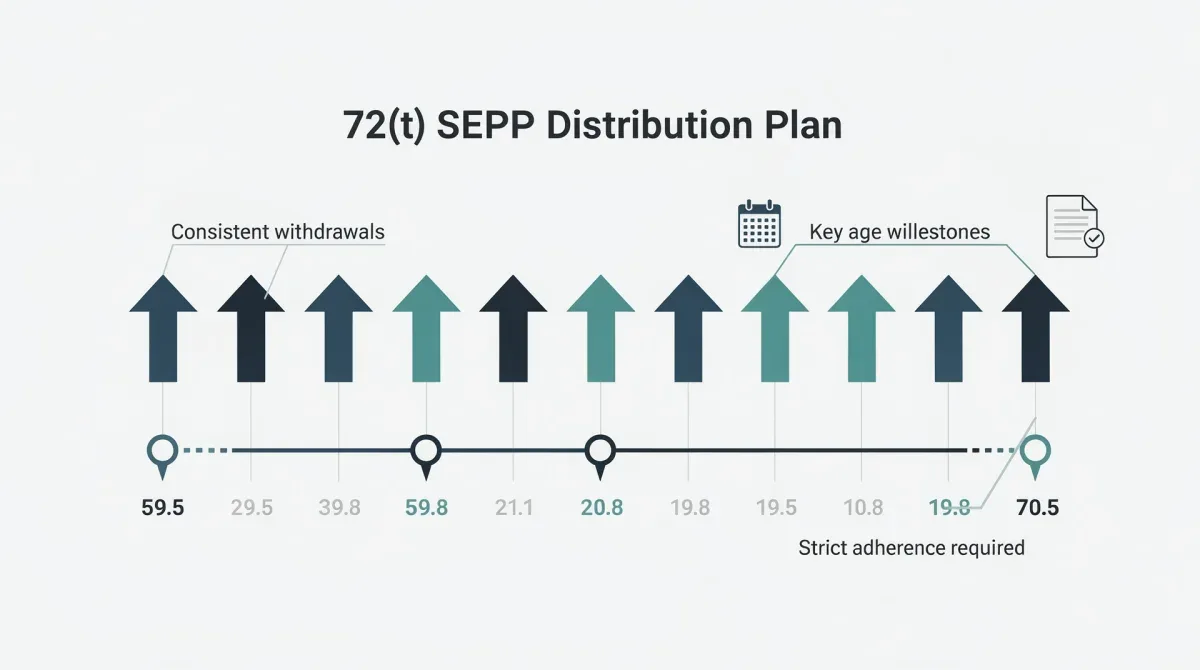
One of the most serious mistakes in a 72(t) SEPP distribution plan is withdrawing a different annual amount from the one required under the applicable calculation method.
Unauthorized modifications can result in the recapture of the 10% additional tax that would otherwise have applied to prior eligible distributions, together with applicable interest. Certain exceptions and permitted changes are recognized by the IRS.
To avoid these problems, review the official IRS guidance on substantially equal periodic payments, document the calculation method, and verify proposed account transactions before executing them.
Alternative Strategies for Early Retirement Access
A 72(t) SEPP distribution plan is not the only possible exception to the additional tax on early retirement withdrawals. Other provisions may apply depending on the account type and personal circumstances.
For example, the separation-from-service exception commonly called the Rule of 55 can apply to certain distributions from qualifying employer retirement plans when employment ends during or after the calendar year the worker reaches age 55.
Some IRA distributions for qualifying higher education costs or eligible first-time home purchases may also meet separate exceptions. These alternatives should be evaluated individually as part of broader retirement planning.
Key Point | Brief Description |
|---|---|
72(t) SEPP Purpose | Provides an exception to the additional 10% early distribution tax when the required payment rules are satisfied. |
Calculation Methods | The RMD, fixed amortization, and fixed annuitization methods provide recognized approaches to calculating payments. |
Strict Adherence | The plan must generally continue until the later of five years after the first payment or age 59½. |
Professional Advice | Qualified tax and financial guidance can help assess calculations, compliance, and retirement planning consequences. |
Frequently Asked Questions About 72(t) SEPP Plans
What is a 72(t) SEPP distribution plan?▼
A 72(t) SEPP distribution plan is an arrangement involving substantially equal periodic payments from eligible retirement accounts. When the applicable conditions are satisfied, the distributions qualify for an exception to the usual 10% additional early withdrawal tax, although regular income taxes may still apply.
Which accounts are eligible for 72(t) SEPP?▼
Eligible arrangements can include traditional IRAs, SEP IRAs, SIMPLE IRAs, and certain employer-sponsored retirement plans. The rules differ by account type, and the SEPP exception for employer plans generally requires separation from service before payments begin. Roth IRA distributions require separate consideration because different withdrawal and tax rules apply.
What are the consequences of modifying a 72(t) plan?▼
Improper modification before the required period ends can trigger additional tax on the current year's distributions and recapture of previously avoided early distribution taxes, plus interest. However, the IRS permits a one-time change from a fixed calculation method to the RMD method and recognizes certain other exceptions.
Do 72(t) distributions reduce my retirement savings?▼
Yes. Withdrawals reduce the assets available for future investment growth and may affect retirement income sustainability. The impact depends on the distribution amount, investment performance, time remaining until retirement, and the individual's broader financial situation.
Is professional advice necessary for a 72(t) plan?▼
Professional assistance is strongly recommended because calculating and maintaining a 72(t) SEPP distribution plan involves detailed IRS requirements. A qualified tax professional or financial planner can help assess calculation methods, account eligibility, payment schedules, and the potential consequences of modifying the arrangement.
What this means
Understanding how to structure a 72(t) SEPP distribution plan requires balancing early access to retirement assets with strict tax compliance and long-term financial sustainability.
The IRS provides recognized calculation methods and limited exceptions to modification restrictions, but the responsibility for maintaining accurate payments and appropriate account activity remains important throughout the required period.
For people considering early retirement, comparing the SEPP exception with other available withdrawal strategies and obtaining qualified tax guidance can help prevent costly mistakes while supporting more informed financial decisions.