Evaluating Defined Outcome Buffer ETFs: Protecting Against Downside
Anúncios
Defined outcome buffer ETFs use options strategies to seek limited downside protection while preserving some equity-market participation over a specified outcome period.
A 15% buffer does not guarantee principal protection, and investors can still experience meaningful losses when the underlying asset declines beyond the protected range.
The trade-off usually includes limited upside, fees and outcome rules that depend heavily on when the investor enters and exits the fund.
What Are Defined Outcome Buffer ETFs?
Defined outcome buffer ETFs are exchange-traded funds designed to seek a predetermined range of investment outcomes over a stated period.
They generally reference an underlying ETF or index and use FLEX Options to shape both potential downside protection and participation in gains.
Anúncios
The resulting structure differs from a traditional index ETF because part of the market exposure is exchanged for a defined buffer and other conditions.
What “Defined Outcome” Actually Means
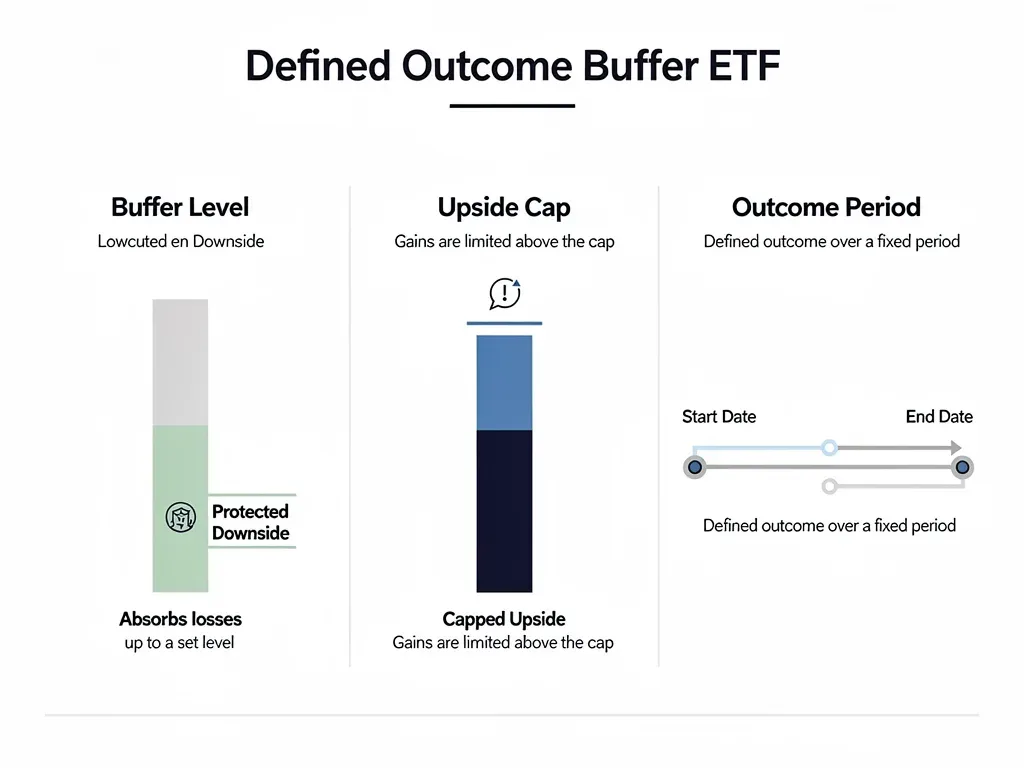
The fund establishes an outcome framework for a specific period, commonly defining a buffer, an upside cap and the underlying asset being referenced.
Those outcomes are targets rather than guarantees, and prospectuses explicitly warn that the stated protection may not be fully realized.
Anúncios
Fees, trading costs and the investor's actual purchase price can also cause results to differ from the headline buffer and cap.
FLEX Options Drive the Structure
Many defined outcome ETFs rely on Flexible Exchange Options, commonly called FLEX Options, instead of directly holding only the underlying index exposure.
These contracts can be customized by strike price and expiration, allowing managers to build a specific payoff profile for the outcome period.
The exact combination varies by fund, so investors should review the prospectus rather than assume every buffer ETF uses identical option positions.
How a 15% Buffer Is Intended to Work
A 15% buffer typically seeks to reduce the first portion of losses experienced by the referenced asset during the applicable outcome period.
If the underlying investment declines within that range, the ETF is designed to absorb some or all of that decline before fees and expenses.
Once losses move beyond the buffer, the shareholder generally begins participating in additional downside according to the fund's specific structure.
A 20% Market Decline Does Not Always Mean a 5% ETF Loss
The simple example of a 20% decline producing exactly a 5% shareholder loss can illustrate the concept but should not be treated as guaranteed.
Fees, trading costs, market pricing and timing can reduce the amount of protection actually experienced by the shareholder.
The prospectus may also define the buffer against the underlying ETF's price return rather than guaranteeing an exact investor-level result.
The Buffer Does Not Protect Against Unlimited Losses
After the protected range has been exhausted, additional declines can expose the investor to substantial losses in the fund.
Regulatory filings explicitly state that buffer ETFs do not provide principal protection and that shareholders can lose significant amounts.
Investors should therefore view the buffer as limited downside mitigation rather than an insurance policy against a severe bear market.
The Outcome Period Is Crucial
The buffer and cap are designed around a specific outcome period that begins and ends on dates established by the fund.
Some funds use annual periods, while others use quarterly, six-month or other structures depending on the product design.
The stated outcome applies most directly to investors who participate throughout the complete period under the assumptions described by the fund.
Buying Mid-Period Changes the Math
An investor who purchases after the outcome period begins does not necessarily receive the same remaining buffer advertised at inception.
If the underlying asset has already fallen, part or all of the intended downside protection may already have been consumed.
If the fund has already risen substantially, the remaining potential upside may also be much lower than the original cap.
Selling Early Can Change the Result
The strategy is generally designed around holding through the end of the outcome period rather than guaranteeing interim market values.
Someone who sells before the period ends may realize a result that differs materially from the targeted buffer or upside participation.
This makes entry date, exit date and current fund position particularly important when evaluating an existing buffer ETF.
Understanding the Upside Cap
Many defined outcome buffer ETFs limit the maximum return available during the outcome period in exchange for providing downside mitigation.
The cap represents the approximate maximum gain the strategy seeks to deliver when held through the complete applicable period.
If the underlying asset rises beyond that level, the shareholder generally does not participate in gains above the stated cap.
The Cap Is Not Fixed Forever
A new cap is usually established when a new outcome period begins and can move higher or lower depending on prevailing market conditions.
Interest rates, volatility and option pricing can all influence how much upside the strategy can provide alongside a given buffer.
This means a fund with a 15% buffer can have very different caps from one outcome period to another.
Two 15% Buffer ETFs Can Offer Different Upside
Funds using the same broad buffer percentage may still have different underlying assets, fees, option structures and outcome periods.
As a result, their caps and expected return profiles can vary substantially even when both advertise a 15% downside buffer.
Investors should compare the current remaining cap rather than selecting a fund based solely on the headline buffer percentage.
15% Buffer Products in 2026
The defined outcome ETF market in 2026 includes several products targeting approximately 15% downside buffers against major equity benchmarks.
Current offerings show that the associated upside varies, reinforcing that buffer size alone does not describe the entire investment proposition.
Estimated caps can also change before an outcome period begins because the final options package depends on market pricing at inception.
Current Products Illustrate the Trade-Off
FT Vest currently lists October 2026 products with 15% moderate buffers and different estimated net cap ranges depending on the specific strategy.
One product references SPY with a moderate buffer, while another uses an enhanced structure that produces a different upside range.
These variations show why investors should review the individual prospectus and current outcome data instead of relying on generic examples.
Fees Reduce the Effective Buffer
The headline buffer is commonly stated before management fees and certain other expenses are taken into account.
That means the shareholder's effective protection can be slightly smaller than the stated percentage after annual fund expenses are included.
Prospectuses often provide both gross and net figures to illustrate how fees affect the expected outcome.
A 15% Headline Buffer May Be Less Than 15% Net
For example, a fund with a stated 15% protection level can deliver a slightly smaller effective buffer after its annual management fee.
Brokerage commissions, taxes and unusual fund expenses can create additional differences at the individual investor level.
This is why prospectus figures should be read carefully before using the headline buffer in portfolio-loss calculations.
Buffer ETFs Do Not Eliminate Volatility
Buffer ETFs can reduce some downside exposure, but their market prices can still move meaningfully during the outcome period.
The FLEX Options themselves do not necessarily change value at the same rate as the underlying ETF throughout every trading day.
Shareholders should therefore expect market fluctuations even when the long-term outcome structure seeks to limit part of the downside.
NAV and Market Price Can Differ
ETF shares trade on an exchange, so transaction prices can differ temporarily from the fund's calculated net asset value.
If an investor sells when shares are trading away from NAV, the realized result may differ from the theoretical buffered outcome.
This adds another reason why the headline buffer should not be interpreted as guaranteed protection for every transaction.
Upside Opportunity Cost Can Be Significant
The cost of receiving downside mitigation is often most visible during strong bull markets when the underlying asset rises well above the cap.
An ordinary equity ETF can continue participating in those gains, while a capped buffer strategy stops benefiting once its limit is reached.
Over several strong outcome periods, repeated caps can produce materially lower cumulative returns than full equity exposure.
Strong Markets Can Make the Buffer Expensive
If stocks rise sharply and avoid meaningful drawdowns, the investor may receive little practical benefit from the downside protection purchased through the structure.
Meanwhile, the upside sacrificed above the cap represents a real opportunity cost relative to holding the underlying ETF directly.
This does not make buffer ETFs inherently poor investments, but it reinforces that they serve a different objective from maximum equity growth.
Where Buffer ETFs May Fit
Buffer ETFs may appeal to investors who want continued equity exposure but are uncomfortable accepting every short-term market decline.
They can occupy a middle ground between full equity participation and more defensive allocations that substantially reduce stock-market exposure.
The appropriate allocation depends on portfolio goals, time horizon, tax situation and the investor's ability to tolerate losses beyond the buffer.
They May Appeal Near Major Financial Goals
Investors approaching retirement or another important spending date may become more sensitive to the sequence and size of equity-market drawdowns.
A buffer strategy can reduce part of that exposure while keeping some connection to future equity-market gains.
However, it should not substitute automatically for a broader asset-allocation review involving cash, bonds and other portfolio components.
Buffer ETFs Versus Traditional Equity ETFs
A conventional broad-market equity ETF generally provides much more direct participation in both gains and losses of its underlying index.
A buffer ETF modifies that profile by sacrificing some potential upside in exchange for a limited amount of downside mitigation.
Neither structure is universally superior because they are designed for different investor objectives and risk tolerances.
Traditional Equity Offers More Upside
An uncapped index fund can continue appreciating when the market experiences a strong rally beyond the limit established by a buffer ETF.
It also exposes the investor more directly to market declines because there is no built-in defined downside buffer.
The comparison therefore comes down to whether the investor values full participation or prefers a more controlled return range.
Buffer ETFs Versus Bonds
A buffer ETF should not be treated as a bond substitute simply because it offers partial downside protection.
Its economic exposure remains tied to equity markets and options, so its behavior differs substantially from traditional fixed-income securities.
Bonds can provide income and different diversification characteristics that a buffered equity strategy does not automatically replicate.
Risk Sources Are Different
Bond investors face interest-rate and credit risks, while buffer ETF investors remain exposed to equity declines beyond the protected range.
The two can therefore play different roles within a diversified portfolio rather than acting as direct substitutes for one another.
Portfolio construction should evaluate those functions separately instead of assuming lower equity volatility makes a buffer ETF equivalent to fixed income.
Buffer ETFs Versus Stop-Loss Orders
Stop-loss orders attempt to exit a position after the market reaches a specified price rather than modifying the payoff profile in advance.
They can execute during temporary volatility and may cause investors to miss a recovery if prices rebound shortly after the sale.
A buffer ETF stays invested and uses options to alter the return profile without relying on an automatic liquidation trigger.
Neither Strategy Guarantees a Perfect Outcome
A stop order may execute at a worse price than expected during fast markets, while a buffer ETF can lose significantly after its buffer is exhausted.
The best choice depends on whether the investor wants an exit mechanism or a predefined range of participation while remaining invested.
Understanding this difference prevents the two tools from being compared solely on the amount of downside an investor hopes to avoid.
Buffer ETFs Versus Direct Option Strategies
Investors can theoretically build similar payoff profiles themselves using combinations of listed or FLEX-style options, depending on access and expertise.
An ETF packages the strategy into a tradable security and handles the option management within the fund structure.
This convenience can make defined outcomes more accessible, but investors still need to understand the resulting cap, buffer and timing rules.
Convenience Does Not Remove Complexity
The ticker may trade like an ordinary ETF, but the economic behavior depends on derivatives whose values change with several market variables.
Investors should therefore understand the prospectus even when they do not personally trade or manage individual option contracts.
A simple brokerage interface does not turn the underlying strategy into the equivalent of a basic passive index fund.
Do Buffer ETFs Reduce Portfolio Drawdowns?
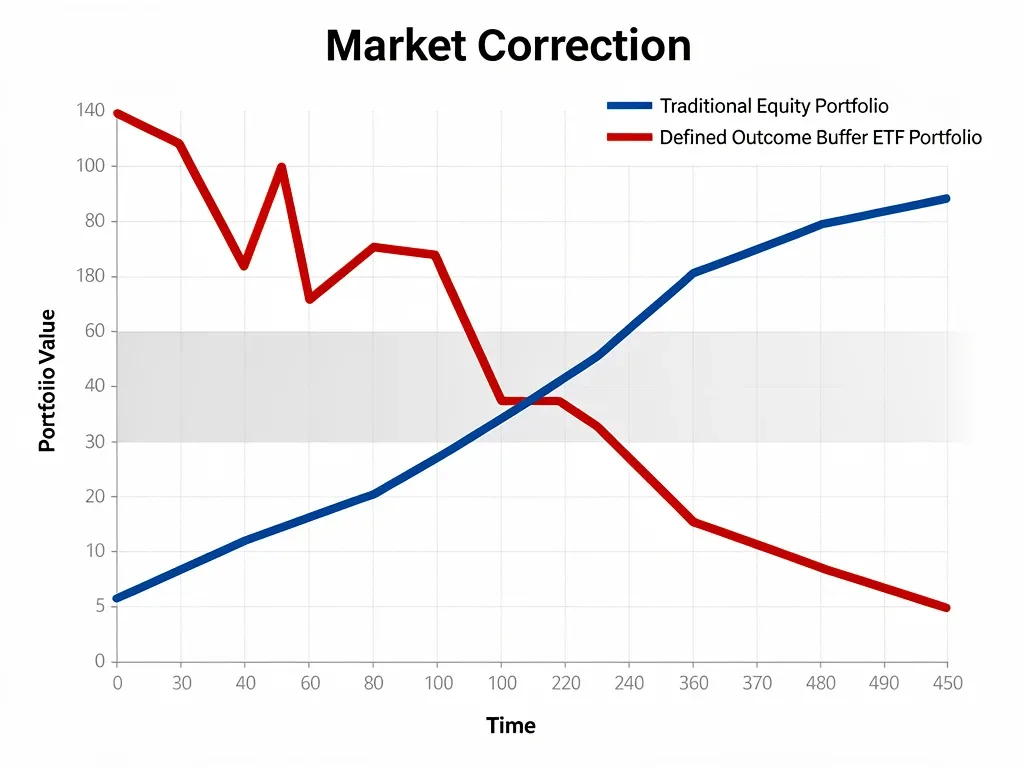
A functioning buffer can reduce the first portion of an eligible decline during the relevant outcome period compared with direct equity exposure.
This may produce smaller drawdowns in certain market environments, particularly when the underlying loss remains within or moderately beyond the buffer.
However, severe declines can still create substantial losses once the intended downside protection is exhausted.
Smaller Drawdowns Can Aid Recovery
Mathematically, a portfolio suffering a smaller loss requires a smaller subsequent percentage gain to return to its previous value.
A 20% decline requires a 25% recovery, while a 10% decline requires approximately 11.1% to return to the starting level.
This is one reason some investors value downside mitigation even when accepting a lower ceiling on future gains.
Current Outcome Data Matters Before Buying
A buffer ETF purchased several months after inception may offer a very different profile from what its original marketing materials describe.
The remaining buffer can shrink, while the remaining upside can expand or contract depending on the underlying asset's movement since inception.
Investors should therefore review current outcome information immediately before purchasing shares rather than relying only on the stated strategy name.
Remaining Buffer and Remaining Cap Are Key
Many issuers publish current estimates showing how much downside protection and upside opportunity remain for investors entering during an active period.
These figures can be more relevant to a new buyer than the original buffer and cap established on the first day.
They should still be understood as estimates rather than guaranteed future returns at the investor's actual transaction price.
Expense Ratios Deserve Attention
Defined outcome ETFs generally charge higher management fees than the lowest-cost traditional index ETFs because their strategies require option management.
Those expenses reduce investment results and should be included when comparing a buffer strategy with direct exposure to the underlying index.
Even modest annual differences can accumulate over long holding periods when the strategy is rolled repeatedly.
Compare Cost With the Protection Received
The relevant question is not simply whether the expense ratio is higher, but whether the investor values the resulting downside structure enough to justify it.
A buffer that meaningfully improves the investor's ability to remain invested may provide behavioral value beyond a simple fee comparison.
But paying more for a structure that does not fit the investor's objectives can reduce long-term returns without providing a useful benefit.
Tax Considerations Can Differ
Defined outcome ETFs may have tax characteristics influenced by their use of options and the specific transactions conducted within the fund.
Investors should not assume their tax experience will be identical to holding a simple broad-market equity ETF directly.
The consequences can depend on account type, distributions, realized gains and individual circumstances during the holding period.
Tax-Advantaged Accounts Change the Analysis
Holding a strategy inside an IRA or another tax-advantaged account can change how current taxable distributions affect the investor.
In a taxable brokerage account, realized gains and distributions may influence after-tax results compared with other portfolio choices.
Investors with meaningful tax concerns should evaluate the specific fund documentation and their individual tax circumstances before allocating capital.
Risk of Losing the Entire Investment
The phrase “15% downside protection” can sound much safer than the legal risk disclosures actually describe for defined outcome funds.
SEC filings explicitly state that shareholders can experience significant losses and may, under extreme circumstances, lose their entire investment.
The strategy therefore limits a portion of intended downside rather than placing an absolute floor beneath the fund's value.
Principal Is Not Guaranteed
These products should not be confused with insured deposits, principal-protected notes or securities carrying a contractual guarantee of repayment.
The buffer represents a target created through the option structure rather than a promise that invested capital cannot fall below a stated level.
This distinction should be understood before using the fund for money that cannot tolerate meaningful market losses.
Questions to Ask Before Investing
Start by identifying the underlying asset, current outcome period, original buffer, remaining buffer, upside cap and remaining upside available today.
Then review the expense ratio, distribution characteristics and how long the investor expects to hold the fund within the broader portfolio.
Finally, compare the strategy with simpler alternatives to determine whether the defined outcome genuinely improves the portfolio's risk-return profile.
Five Details to Verify
Confirm the exact outcome start and end dates because those determine when the strategy's target parameters are measured.
Check whether the buffer applies to the first losses or to a specific range, since some products use structures that differ from simple first-loss protection.
Review the prospectus language on fees and timing because those details can materially change the outcome experienced by an individual shareholder.
Current remaining buffer.
Current remaining upside or cap.
Outcome-period start and end dates.
Expense ratio and other costs.
Underlying ETF or index exposure.
When a 15% Buffer May Be Reasonable
A 15% buffer can appeal to investors who want more downside mitigation than a 5% or 10% product without moving to a deeper buffer structure.
The choice should still depend on the upside surrendered, because stronger protection can come with a lower cap or different return characteristics.
Comparing several products with different buffer levels can clarify how much growth potential the investor is willing to exchange for additional protection.
There Is No Universally Optimal Buffer
A younger investor focused on long-term growth may prefer full equity exposure, while another approaching withdrawals may value more downside mitigation.
Even investors with similar ages can have different portfolio sizes, income sources, liabilities and psychological tolerance for temporary losses.
The appropriate buffer therefore depends on the investor's broader financial plan rather than one market forecast or volatility expectation.
What Happens at the Reset Date?
At the end of an outcome period, the fund establishes a new options package and begins another defined outcome cycle.
The new cap can differ materially from the previous period because option prices, interest rates and volatility may have changed.
Investors who continue holding automatically transition into the new outcome framework rather than retaining the old cap and buffer indefinitely.
Review the New Terms Before Staying Invested
An outcome profile that was attractive one year may become less appealing after the fund establishes a lower cap for the next period.
Conversely, more favorable market pricing can sometimes allow a stronger participation level alongside the same nominal buffer.
Periodic review is therefore important even for investors who intend to use buffer ETFs as long-term portfolio allocations.
How to Compare Two Buffer ETFs
Comparing only the headline buffer can lead to poor decisions because funds may differ in underlying exposure, cap, expenses and outcome timing.
A useful comparison should place current buffer, remaining upside, fees and exact outcome dates side by side for each product.
Investors should also determine whether both strategies define the protected range in the same way before assuming they are equivalent.
Focus on the Investor's Entry Point
The most relevant comparison is the outcome available from the price at which the investor can actually purchase the shares today.
An ETF that originally offered a higher cap may now have little remaining upside after a strong rally earlier in its outcome period.
A different fund beginning a fresh period may therefore offer a more attractive current profile despite having similar branding or headline protection.
Defined Outcomes Are Targets, Not Guarantees
The word “defined” can create an impression of certainty that is stronger than the actual legal language used in fund prospectuses.
Issuers consistently disclose that there is no guarantee the ETF will achieve the intended cap or provide the complete stated buffer.
Market behavior, fees, transaction timing and operational factors can all affect the shareholder's realized investment outcome.
Read the Prospectus Risk Section
The risk disclosure explains circumstances where shareholders can receive less downside protection or less upside than the fund's headline objective suggests.
It also describes risks associated with FLEX Options, market movements, liquidity and the timing of investor purchases and sales.
Those disclosures are essential reading because they describe the strategy more accurately than a marketing phrase such as “15% downside protection.”
Frequently Asked Questions About Buffer ETFs
Does a 15% buffer guarantee that I cannot lose the first 15%?
No. The fund seeks to provide that buffer under specified conditions, but prospectuses state that the intended protection is not guaranteed.
What happens if the market falls 25%?
After the buffer is exhausted, the investor is generally exposed to additional losses, with the exact result depending on the fund structure, timing and costs.
Can I buy a buffer ETF in the middle of the outcome period?
Yes, but the remaining buffer and remaining upside can differ substantially from the levels available at the beginning of the period.
Does every buffer ETF have an upside cap?
Many do, although some defined outcome structures use alternative payoff designs. Investors should verify the exact terms of the specific fund.
Why does the cap change each year?
Option prices, interest rates, volatility and market conditions influence the options package used to establish the new outcome period.
Are buffer ETFs principal-protected?
No. They are market investments and can experience substantial losses. A downside buffer is not the same as a guarantee of principal.
Are buffer ETFs suitable for retirement portfolios?
They may fit some retirement strategies, but suitability depends on allocation, income needs, time horizon, taxes and tolerance for losses beyond the buffer.
Conclusion
Defined outcome buffer ETFs can reshape equity risk by seeking to absorb a limited portion of market losses during a specified outcome period.
The protection comes with important trade-offs, including capped or otherwise limited upside, fees, timing sensitivity and substantial losses beyond the buffer.
Investors should evaluate the current outcome profile and prospectus rather than treating “15% downside protection” as a guaranteed safety level.