Cash Balance Pension Plan: Shelter $200K+ from Taxes
Anúncios
A cash balance pension plan may allow qualifying businesses to make more than $200,000 in annual tax-deductible retirement contributions under certain circumstances. Learn how these plans work, the 2026 retirement limits, eligibility requirements, funding obligations, and potential tax benefits.
A cash balance pension plan can provide business owners with an additional way to save for retirement while potentially reducing current taxable income through qualifying employer contributions.
Some businesses can contribute more than $200,000 annually, but this amount is not available to everyone. Contributions depend on actuarial calculations, plan design, participant characteristics, and applicable tax rules.
This guide explains how cash balance plans work in 2026, which businesses may benefit, and how to evaluate deductions, administrative costs, and long-term funding responsibilities.
Understanding the Cash Balance Pension Plan Structure
A cash balance pension plan is a type of defined benefit retirement plan that presents participants' benefits through hypothetical individual account balances.
Anúncios
These balances generally increase through employer-provided pay credits and interest credits determined by the plan's terms. The structure resembles a retirement savings account.
However, cash balance plans differ significantly from 401(k) arrangements. Employers generally bear the investment and funding risks associated with delivering promised benefits.
How Cash Balance Plans Work
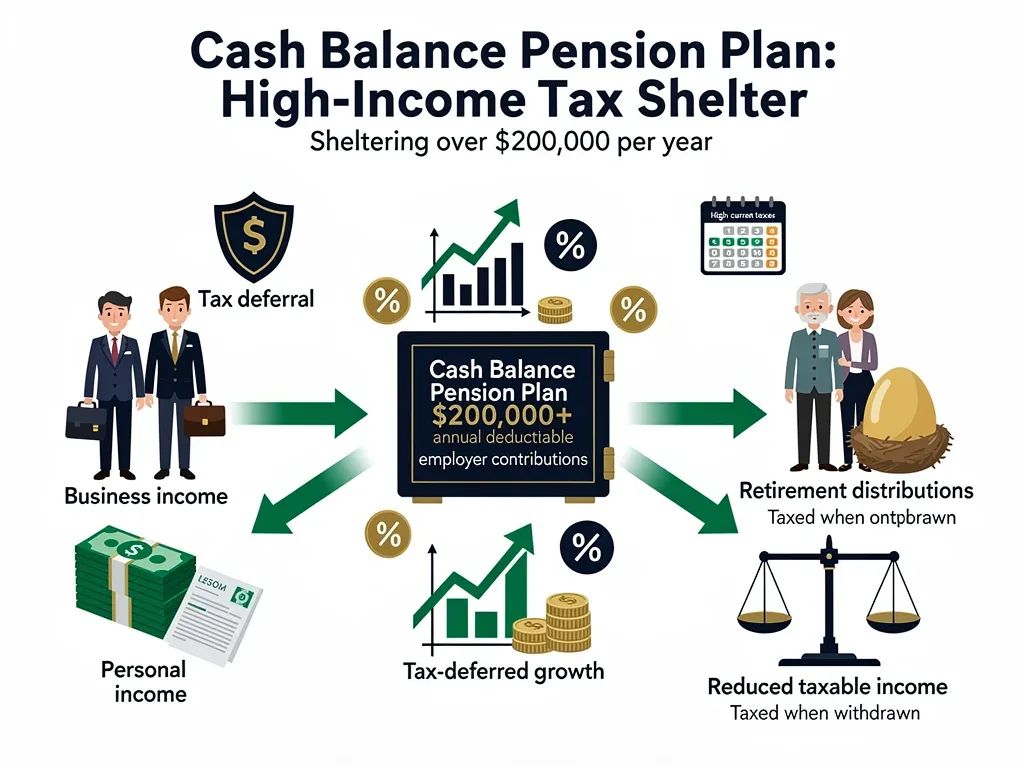
Each eligible participant receives a hypothetical account that tracks retirement benefits according to the plan's formula rather than an individually owned investment account.
Anúncios
A typical cash balance pension plan may credit a percentage of compensation annually, along with an interest credit based on a predetermined formula.
The employer funds the plan's overall obligations. Actual investment performance can affect required future contributions even when participant benefits follow the stated formula.
Key Features and Benefits for Business Owners
A major advantage of a cash balance pension plan is its potential to support substantial retirement funding for eligible owners and employees.
Qualified employer contributions may be deductible under applicable tax rules. Nevertheless, allowable deductions depend on statutory limits and actuarial calculations.
Plans must also satisfy employee coverage, nondiscrimination, vesting, and other requirements. Owners cannot simply exclude eligible employees to maximize their own benefits.
Defined Benefit Structure: Retirement benefits are determined by a formula established in the plan.
Potentially Large Contributions: Qualifying plans may support substantial employer funding.
Tax Treatment: Permissible employer contributions may reduce current taxable income.
Participant Accounts: Hypothetical balances receive pay credits and interest credits.
Employer Responsibility: The business generally bears investment and funding risk.
How Cash Balance Plans Can Support Contributions Above $200,000
A cash balance pension plan may permit annual employer contributions exceeding $200,000 when supported by the plan's design and actuarial funding requirements.
The appropriate contribution depends on several factors, including compensation, age, accumulated benefits, retirement assumptions, and existing plan assets.
A $200,000 deductible contribution is not the same as $200,000 in tax savings. Actual tax savings depend on the applicable tax rate and the taxpayer's circumstances.
Cash Balance Pension Plan Limits in 2026
Retirement plan limits change periodically, so business owners should verify the rules applying to the year in which contributions are made.
For 2026, the IRS established a $290,000 annual defined benefit limit under Section 415(b), subject to additional statutory conditions.
This figure limits the annual retirement benefit under applicable rules. It does not mean every participant can contribute $290,000 to a cash balance pension plan each year.
Defined Benefit Limits Versus Annual Contributions
Defined benefit plans operate differently from retirement accounts that have straightforward annual contribution ceilings.
A cash balance pension plan uses actuarial assumptions to determine the funding necessary to provide the promised retirement benefits.
The funding calculation must consider statutory benefit limits and other requirements. Contributions above a particular amount cannot be assumed permissible without professional analysis.
How the 2026 Rules Compare With a 401(k)
For 2026, the employee elective deferral limit for a typical 401(k) plan is $24,500, before applicable catch-up contributions.
The general defined contribution annual additions limit is $72,000, excluding applicable catch-up contributions and subject to compensation-related restrictions.
Because a cash balance pension plan follows defined benefit rules, its funding calculations differ from those limits. Combining plans requires additional coordination.
2026 Employee 401(k) Deferral Limit: $24,500 before applicable catch-up contributions.
2026 General Defined Contribution Limit: $72,000 in annual additions, subject to applicable rules.
2026 Defined Benefit Annual Benefit Limit: $290,000, subject to statutory adjustments and restrictions.
Cash Balance Contributions: Determined through actuarial funding calculations rather than a universal fixed annual deposit limit.
Eligibility and Ideal Candidates for a Cash Balance Plan
A cash balance pension plan can be appropriate for certain businesses with predictable earnings and a willingness to maintain long-term retirement obligations.
Professional service firms, medical practices, consulting businesses, and other companies with stable profitability may find these plans worth evaluating.
However, business type alone does not establish suitability. Workforce demographics, employee benefit costs, financial stability, and ownership goals all matter.
Who Benefits Most From a Cash Balance Pension Plan?
Business owners approaching retirement may benefit from plan designs that allow substantial funding toward defined retirement benefits.
For an older high-income owner, a cash balance pension plan may permit larger contributions than a conventional defined contribution arrangement, depending on actuarial factors.
Younger owners may also benefit in suitable circumstances. There is no universal minimum age or income level that automatically makes the plan appropriate.
Why Stable Business Cash Flow Matters
Cash balance plans create funding obligations that may continue even when a business experiences lower profits or disappointing investment returns.
A company considering a cash balance pension plan should assess whether it can support required contributions across different financial conditions.
Businesses with highly unpredictable income may find these obligations difficult to manage. A funding projection should consider both favorable and unfavorable scenarios.
Considerations for Implementation
Establishing a cash balance pension plan requires professional plan design, actuarial calculations, and coordination with existing retirement arrangements.
Employers must consider participant eligibility, benefit formulas, nondiscrimination testing, funding responsibilities, and administrative costs before adopting the plan.
The decision should also fit a broader retirement financial planning strategy rather than focusing exclusively on a single year's deduction.
How Much Could a $200,000 Contribution Reduce Taxes?
The tax advantage of a cash balance pension plan is often misunderstood because retirement contributions and actual tax savings are different amounts.
A qualifying deductible contribution may reduce taxable income, but the resulting savings depend on the business structure, applicable tax rates, and deduction limitations.
For accurate planning, businesses should calculate the estimated tax impact with a qualified tax professional rather than assume that the entire contribution becomes a tax refund.
A Practical Example of Tax Deferral
Consider a hypothetical business that qualifies to deduct a $200,000 employer contribution to its retirement plan.
If the relevant effective marginal tax rate on that deductible amount were 30%, the illustrative reduction in current taxes would be approximately $60,000.
The business would still contribute $200,000 to fund retirement benefits. This simplified cash balance pension plan example excludes other taxes, entity-specific treatment, and future taxation.
Illustrative Deductible Contribution: $200,000.
Assumed Applicable Tax Rate: 30%.
Estimated Current Tax Reduction: $60,000.
Amount Contributed to the Plan: $200,000.
Future Taxation: Distributions may be taxable depending on how benefits are received.
Tax Deferral Is Different From Permanent Tax Elimination
Many qualified retirement arrangements defer taxation rather than remove it permanently. Tax treatment depends on the contribution and distribution rules.
When a cash balance pension plan makes qualifying contributions, the current deduction may provide a financial benefit while assets accumulate for retirement.
Future benefits may be taxable upon distribution. A comprehensive evaluation should consider anticipated retirement taxation as well as the immediate deduction.
Comparing Cash Balance Plans to Other Retirement Options
Businesses can choose among different retirement arrangements, including 401(k), profit-sharing, SEP IRA, and defined benefit plans.
A cash balance pension plan differs because retirement benefits are determined by a formula, while defined contribution plans primarily depend on account contributions and investment performance.
The right choice depends on cash flow, workforce characteristics, business objectives, and administrative capacity. Larger possible contributions do not automatically mean a better plan.
Cash Balance vs. 401(k) and Profit Sharing
A 401(k) plan generally allows employees to defer part of their compensation, with possible employer contributions according to the plan's terms.
A cash balance pension plan instead promises benefits calculated under a defined benefit formula and requires actuarial oversight.
For owners comparing their options, understanding individual retirement accounts and workplace plans can help place these alternatives within a broader savings strategy.
Combining Plans for Maximum Tax Efficiency
Some businesses establish both a defined benefit arrangement and a 401(k) or profit-sharing plan to address different retirement objectives.
This combination can increase overall retirement funding opportunities, but a cash balance pension plan and defined contribution plan must comply with applicable combined deduction and nondiscrimination rules.
A professional should model the total employer cost, including benefits for eligible employees. Combining plans does not permit unlimited deductions.
Understanding Catch-Up Contributions
Catch-up contributions may allow eligible participants to defer additional amounts into certain defined contribution plans beyond regular annual deferral limits.
These rules differ from the actuarial funding requirements of a cash balance pension plan. They should not be treated as interchangeable contribution limits.
Business owners reviewing combined arrangements should also understand the 2026 retirement catch-up contribution rules and their potential implications.
Regulatory Compliance and Administration
A cash balance pension plan is subject to federal retirement plan requirements, including relevant Internal Revenue Code and ERISA provisions.
Employers must operate the plan consistently with its written terms, funding obligations, participant protections, and reporting responsibilities.
Compliance failures can create financial and tax consequences. Professional administration is important because defined benefit plans involve more complex obligations than many account-based arrangements.
Navigating IRS and ERISA Requirements
Qualified cash balance arrangements must satisfy applicable eligibility, vesting, accrual, nondiscrimination, and funding requirements.
A cash balance pension plan may also require Form 5500 reporting and other documentation depending on the plan's characteristics and applicable exemptions.
Employers should verify annual deadlines and reporting requirements with their administrators. Compliance cannot be established solely through adopting a standard plan document.
The Role of Actuaries and Third-Party Administrators
Enrolled actuaries or other appropriately qualified professionals perform important functions in calculating required contributions and evaluating funding obligations.
Third-party administrators may coordinate participant records, compliance testing, government filings, and distributions for a cash balance pension plan.
These responsibilities should be clearly assigned. Engaging specialists does not eliminate the employer's duty to operate the plan properly.
Administrative Costs and Funding Risks
Cash balance arrangements commonly require professional services that create additional expenses beyond the retirement contributions themselves.
The employer funding a cash balance pension plan may also need to make additional contributions when investment results or actuarial assumptions differ from expectations.
Before implementation, request estimates for setup, annual administration, actuarial services, employee benefits, and potential future funding adjustments.
Illustrative Business Scenarios for Cash Balance Plans
Different businesses may have very different outcomes when evaluating a cash balance pension plan. Workforce composition and financial stability strongly influence plan suitability.
The following scenarios are hypothetical examples designed to explain important considerations. They do not represent verified company case studies or guaranteed contribution amounts.
Actual recommendations require detailed actuarial and tax analysis based on the characteristics of the employer and its employees.
Scenario 1: A Profitable Medical Practice
Consider a medical practice with several high-income partners who want to increase retirement savings while maintaining benefits for eligible staff.
A cash balance pension plan may allow the practice to evaluate additional defined benefit funding beyond existing retirement arrangements.
However, the partners must consider employee benefit requirements, required funding levels, and the practice's ability to maintain the plan during less profitable years.
Scenario 2: A Solo Consultant Approaching Retirement
Imagine a self-employed consultant in their late fifties with consistently high earnings and limited time remaining before a planned retirement.
Depending on the consultant's compensation history, existing retirement benefits, and actuarial assumptions, a cash balance pension plan could support substantial contributions.
Yet a contribution above $200,000 cannot be assumed. The permitted and required amounts depend on individualized calculations and legal limitations.
Scenario 3: A Business With Unpredictable Revenue
A company experiencing large swings in annual income may be attracted by potential tax deductions but have difficulty forecasting future cash availability.
Because a cash balance pension plan creates continuing funding responsibilities, uncertain earnings can make the arrangement less attractive.
The business may need to compare other retirement options with different contribution structures before committing to a defined benefit plan.
Long-Term Wealth Accumulation and Retirement Planning
A cash balance pension plan can be a component of a long-term retirement strategy when its contribution levels and benefit obligations are sustainable.
Consistent funding can help accumulate resources for future retirement benefits, but market performance and actuarial requirements influence the employer's funding position.
Distributions, rollovers, and retirement income choices must follow the plan's provisions and applicable tax rules. Participants should understand available options before retirement.
Understanding Distribution and Rollover Options
Cash balance plans generally provide defined retirement benefits, frequently expressed through a hypothetical account balance rather than a traditional monthly pension formula.
Many plans offer eligible participants a lump-sum distribution option, subject to plan provisions and applicable participant protections.
When permitted, an eligible distribution from a cash balance pension plan may be rolled over into another qualified retirement arrangement or IRA under applicable rules.
Coordinating Retirement Assets and Tax Planning
Business owners should evaluate defined benefit arrangements alongside existing savings, investment accounts, and other retirement resources.
The tax effects of a cash balance pension plan can change over time as business income, contribution levels, and retirement circumstances evolve.
Some owners may also compare separate strategies such as 401(k) mega backdoor Roth conversions, where available and appropriate, without assuming identical tax treatment.
Future Outlook and Trends in Retirement Planning
The appeal of a cash balance pension plan comes from its ability to combine defined retirement benefits with potentially substantial employer contributions.
Changes in interest rates, actuarial assumptions, and tax rules can influence funding strategies and the relative attractiveness of different plans.
Businesses should evaluate current regulations rather than rely on generalized forecasts about retirement policy. Professional reviews remain necessary when circumstances change.
Emerging Strategies and Adaptations
Technology can help retirement plan administrators organize participant information, prepare reports, and monitor funding requirements.
However, administering a cash balance pension plan still requires qualified professionals to evaluate actuarial and compliance matters.
Business owners should prioritize accurate recordkeeping and transparent reporting over claims that digital administration can eliminate regulatory complexity.
Why Cash Balance Plans Remain Relevant
For businesses with stable profitability and owners seeking significant retirement funding, a cash balance pension plan may offer useful planning opportunities.
These arrangements can complement other retirement strategies, but the advantages depend on total plan costs, deductible contribution capacity, and funding obligations.
Broader financial planning may also include considerations such as the 2026 estate planning tax environment, where relevant to the owner's overall circumstances.
How to Decide Whether a Cash Balance Plan Is Right for Your Business
The decision to establish a cash balance pension plan should begin with financial analysis rather than an assumption that a large deduction will always justify the cost.
Employers need to evaluate projected cash flow, expected benefit costs, workforce eligibility, actuarial obligations, and the tax treatment applicable to their business.
A qualified actuary, retirement plan administrator, and tax advisor can help compare scenarios before the company adopts a binding retirement arrangement.
Five Questions to Ask Before Establishing the Plan

Business owners should request detailed projections rather than relying on examples that assume exceptionally high contribution levels.
A proposed cash balance pension plan should identify expected annual funding, administrative expenses, employee coverage obligations, and possible future adjustments.
Understanding these details makes it easier to compare alternative retirement structures and determine whether the company can maintain the plan responsibly.
Funding Capacity: Can the business support contributions during lower-profit years?
Contribution Projection: What amounts are supported by actuarial calculations?
Employee Benefits: What costs and participation obligations apply to eligible staff?
Tax Impact: How much would qualified deductions actually reduce current taxes?
Long-Term Obligations: What are the risks, administrative expenses, and termination considerations?
Conclusion
A cash balance pension plan can offer substantial retirement funding opportunities for some profitable businesses, including situations where annual contributions exceed $200,000.
However, these contributions are not automatically available or deductible for every employer. Tax savings also differ from the total amount deposited into the plan.
Business owners should consider employee obligations, actuarial funding, tax limitations, and administrative expenses before adopting a plan. Individualized professional analysis is essential.
Key Point | Brief Description |
|---|---|
High Contribution Potential | Actuarially determined funding may exceed conventional defined contribution limits in qualifying situations. |
Tax Deduction Potential | Qualifying employer contributions may reduce taxable income; deductions are not equivalent to dollar-for-dollar tax savings. |
Ideal Candidates | Businesses with stable profitability, suitable workforce characteristics, and a commitment to long-term funding. |
Combined Plan Strategy | Cash balance and 401(k) plans may work together, subject to applicable contribution, deduction, and compliance rules. |
Frequently Asked Questions About Cash Balance Pension Plans
What is a cash balance pension plan?▼
A cash balance pension plan is a defined benefit retirement plan that calculates benefits through hypothetical participant accounts. These balances typically receive employer pay credits and interest credits under the plan's terms. The employer generally bears the investment risk associated with providing promised benefits.
How much can I shelter annually with a cash balance plan?▼
Some qualifying businesses may make deductible contributions exceeding $200,000 annually, but there is no universal contribution amount. Permissible funding depends on actuarial calculations, plan design, compensation, age, existing benefits, and applicable tax restrictions. A $200,000 deduction does not equal $200,000 in tax savings.
Is a cash balance plan suitable for all businesses?▼
No. These plans may be appropriate for businesses with sufficient profitability, predictable cash flow, and a willingness to meet ongoing retirement funding obligations. Employee demographics, administrative costs, and other factors can make alternative retirement arrangements more suitable.
Can a cash balance plan be combined with other retirement plans?▼
Yes. A cash balance pension plan can sometimes be combined with a 401(k) or profit-sharing plan. However, the employer must satisfy applicable deduction limits, employee coverage rules, nondiscrimination requirements, and other restrictions. Contributions cannot be assumed unlimited simply because two plan types are offered.
What are the administrative requirements for a cash balance plan?▼
Cash balance plans generally require actuarial oversight, appropriate funding, compliance testing, participant disclosures, recordkeeping, and applicable government filings. Specific requirements vary by plan. Businesses commonly work with actuaries, third-party administrators, and tax advisors to manage these responsibilities.
What This Means for Business Owners
The potential to make substantial deductible contributions makes a cash balance pension plan worth considering for certain high-income business owners in 2026.
Nevertheless, the strategy involves significant commitments beyond the immediate tax deduction. Employee benefit costs, funding risks, and administration can materially affect its suitability.
The most effective approach is to request a personalized actuarial projection and evaluate the entire retirement strategy before adopting the plan or committing to substantial contributions.