Direct Indexing vs. S&P 500 ETFs: 1.8% Tax-Loss Alpha
Anúncios
Explore direct indexing tax-loss harvesting and how it compares with traditional S&P 500 ETFs. Learn about the potential 1.8% tax alpha estimate, portfolio customization, wash sale rules, fees, and long-term after-tax returns.
Direct indexing tax-loss harvesting is attracting attention among investors looking to improve the tax efficiency of their portfolios. Unlike traditional S&P 500 exchange-traded funds, direct indexing allows investors to own individual stocks and selectively realize losses while maintaining exposure to a chosen market benchmark.
Some analyses suggest that tax-loss harvesting strategies can generate approximately 1.8% in annual tax alpha under certain assumptions. However, this is not a guaranteed return, and actual results depend on market conditions, tax rates, investment costs, and the investor's ability to use realized losses.
Understanding these differences is essential before replacing a low-cost ETF with a more complex investment strategy. This guide compares direct indexing with conventional index funds, explains the tax implications, and explores which investors may benefit from greater portfolio customization.
Direct Indexing Tax Harvesting: A New Frontier in Wealth Management
Direct indexing is an investment approach in which an investor owns a collection of individual securities designed to approximate the performance of a particular index.
Anúncios
For example, a portfolio tracking the S&P 500 may hold hundreds of individual stocks rather than shares of a single ETF. Portfolio managers can adjust the holdings to maintain market exposure while incorporating tax and customization preferences.
The potential advantage of direct indexing tax-loss harvesting comes from the ability to realize capital losses on individual securities even when the overall market benchmark has increased in value.
This gives investors more opportunities to manage taxable gains than they would have by owning only one broad-market ETF.
Anúncios
However, direct indexing also introduces management complexity, transaction considerations, tracking differences, and potentially higher fees.
Investors should therefore evaluate the strategy as one component of their broader investment planning, rather than assuming it will always outperform conventional index funds.
Understanding the Mechanics of Direct Indexing
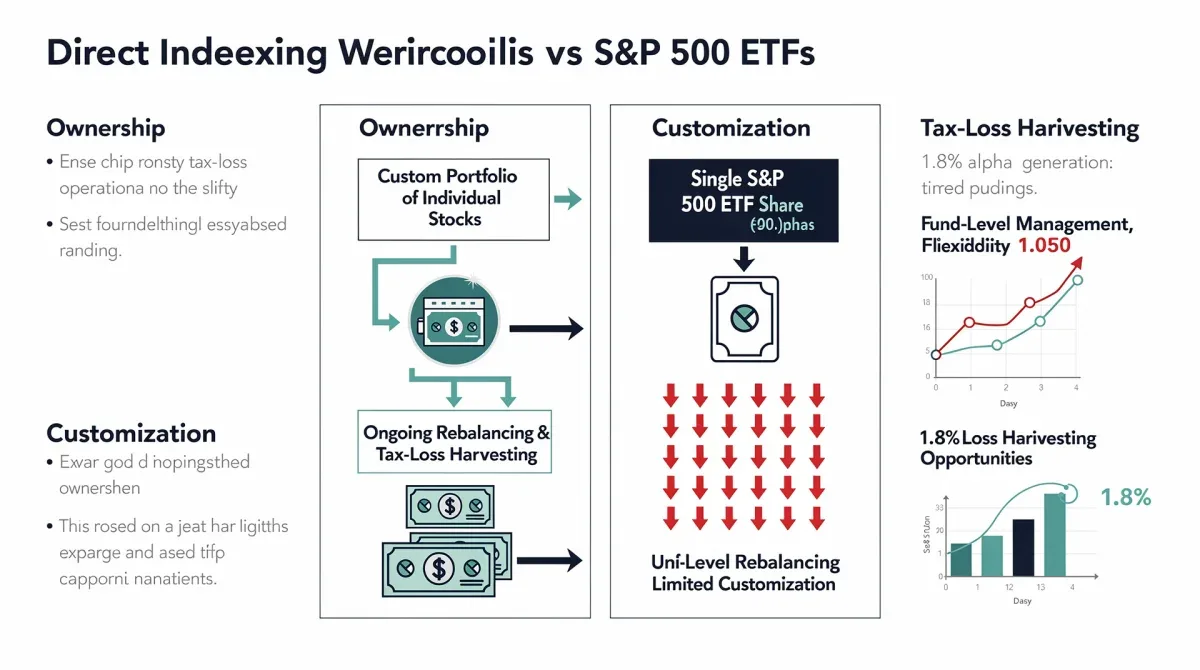
Direct indexing begins with the selection of a benchmark, such as the S&P 500, which represents the performance of approximately 500 leading U.S. companies.
Instead of purchasing shares of a fund, the investor directly owns selected companies included in the benchmark.
Depending on account size and platform design, the portfolio may hold all constituent stocks or use a representative sample intended to approximate index performance.
When an individual security declines below its tax cost basis, the portfolio manager may sell it to realize a capital loss.
The manager can then purchase a different security or adjust other holdings to maintain appropriate market exposure, subject to applicable tax rules and investment restrictions.
For example, imagine a portfolio that owns shares of several technology, financial, healthcare, and industrial companies.
If one stock experiences a significant decline while the broader index remains relatively stable, selling that position may create a realized capital loss.
That loss may help offset capital gains elsewhere in the investor's taxable portfolio, depending on the individual's circumstances.
The Nuances of Portfolio Construction
Constructing a direct indexing portfolio requires balancing index exposure, individual investment restrictions, tax opportunities, and overall risk.
One challenge is that removing or reducing certain holdings can cause portfolio performance to differ from the benchmark.
Professional platforms frequently use portfolio optimization software to evaluate these trade-offs and identify opportunities for tax-efficient transactions.
Customization: Investors may exclude selected companies or industries according to personal preferences and portfolio restrictions.
Tax Management: Individual holdings provide additional opportunities to realize capital losses.
Portfolio Rebalancing: Managers can adjust positions to control deviations from the target benchmark.
Tracking Error: Differences in holdings may cause returns to diverge from the underlying index.
Customization can be useful when an investor already holds substantial shares of a particular company through employment or another account.
However, concentrated positions, stock exclusions, and tax-related transactions may make it harder to replicate the index precisely.
That is why direct indexing tax-loss harvesting requires an evaluation of both tax efficiency and investment performance.
The Alpha Advantage: 1.8% in Tax-Loss Harvesting
Tax alpha refers to the additional value that tax-management decisions may create compared with an alternative investment strategy.
In direct indexing, this value generally comes from realizing losses that can offset taxable capital gains or provide other permitted tax benefits.
Some research and provider illustrations suggest that tax-loss harvesting can produce an annual benefit near 1.8% under certain assumptions.
However, this figure should not be interpreted as a predictable investment return or an amount that every investor receives.
The actual benefit varies according to tax rates, the frequency of harvesting opportunities, portfolio contributions, available capital gains, and future transactions.
Market volatility can create opportunities because individual securities may decline even when a diversified portfolio performs relatively well.
Nevertheless, sustained increases in stock prices can reduce the number of positions trading below their cost basis.
As a portfolio becomes more appreciated over time, the availability of harvestable losses may also decline unless new contributions or other transactions create additional tax lots.
How Direct Indexing Outperforms ETFs on Taxes
The primary advantage of direct indexing is the ability to evaluate individual securities rather than treating the portfolio as one investment.
For example, an S&P 500 ETF investor may be unable to realize a loss on the fund because its overall market value remains above the purchase price.
Meanwhile, a direct indexing investor could hold several individual stocks that have declined, creating opportunities to realize losses despite an overall positive portfolio return.
These opportunities must still comply with the Internal Revenue Service's rules regarding wash sales and capital losses.
Individual Stock Losses: Direct indexing can harvest losses from selected securities without selling an entire index position.
Capital Gain Offsetting: Realized losses may reduce taxable capital gains elsewhere in a portfolio.
Loss Carryforwards: Eligible unused capital losses may be carried into future tax years.
Tax-Lot Management: Portfolio managers may select particular purchase lots when realizing gains or losses.
However, traditional ETF investors can also practice tax-loss harvesting by selling an ETF at a loss and purchasing an appropriate replacement investment.
The difference is the number and variety of opportunities available, not the exclusive ability to harvest losses.
Under general federal rules, net capital losses may offset up to $3,000 of ordinary income annually, or $1,500 for married taxpayers filing separately.
Additional eligible losses may generally be carried forward, subject to applicable tax rules.
Investors should also understand that harvesting a loss and purchasing a replacement security may reduce the tax basis of the new investment relative to the original holding.
This can create larger taxable gains when the replacement investment is eventually sold.
Therefore, some of the benefit of direct indexing tax-loss harvesting may come from tax deferral rather than permanent tax elimination.
Comparing Direct Indexing with Traditional S&P 500 ETFs
Traditional S&P 500 ETFs remain popular because they offer diversified exposure to large U.S. companies through a single investment.
Many index ETFs feature relatively low expense ratios, transparent holdings, and straightforward portfolio management.
Direct indexing seeks similar market exposure while offering greater control over underlying securities.
However, this flexibility may require additional administration, management fees, and careful coordination of tax-sensitive transactions.
For investors with limited taxable capital gains or relatively low tax rates, the potential benefits may not justify the additional complexity.
By contrast, investors with substantial taxable assets, recurring capital gains, or concentrated stock positions may have more reasons to consider personalized indexing.
Key Differentiators in Investment Management
The distinction between the two strategies extends beyond tax-loss harvesting.
Direct indexing can support individual stock exclusions, customized investment restrictions, and coordination with existing positions.
An ETF generally provides exposure to a predetermined portfolio without allowing individual shareholders to control the underlying securities.
However, ETFs often simplify diversification, rebalancing, tax reporting, and ongoing portfolio maintenance.
Investors comparing the two approaches should evaluate their complete financial picture rather than focusing exclusively on a projected tax alpha percentage.
A useful comparison includes direct and indirect costs, expected tracking differences, the investor's tax circumstances, and the possibility of future taxable gains.
For some households, a low-cost ETF may remain the more suitable investment despite offering fewer individual security harvesting opportunities.
Implementation Considerations for Direct Indexing
Implementing direct indexing tax-loss harvesting requires an account capable of holding and managing numerous individual securities.
Investors should first determine whether their portfolio size meets the platform's minimum requirements.
While some services have reduced their investment minimums, direct indexing is not necessarily economical for every account size.
Fees can also vary substantially between providers. Some platforms charge an asset-based management fee, while others may include additional advisory or service costs.
These expenses must be compared with the potential tax benefit and any differences in investment performance.
For example, if a strategy creates a hypothetical gross tax benefit of 1.0% but introduces an additional annual cost of 0.40%, the remaining benefit before other effects would be 0.60%.
That illustration excludes potential tracking differences, trading costs, future taxable gains, and changes in the investor's individual tax circumstances.
Choosing the Right Platform and Advisor
Investors should evaluate direct indexing providers based on tax-management procedures, investment flexibility, fees, and the transparency of performance reporting.
It is also important to understand how the platform identifies replacement securities when realizing losses.
The IRS wash sale rule generally disallows a loss deduction when substantially identical securities are acquired within 30 days before or after a sale at a loss.
This creates a 61-day window that must be considered when coordinating transactions.
Tax Coordination: Determine whether the platform considers transactions in other relevant accounts.
Management Costs: Compare fees with low-cost index ETF alternatives.
Portfolio Tracking: Ask how closely the strategy is designed to follow its benchmark.
Reporting: Request clear information about realized losses, deferred gains, and after-tax results.
Investors should be particularly careful when the same or substantially identical securities are traded across multiple accounts, including certain retirement accounts.
The IRS Publication 550 on Investment Income and Expenses explains wash sale restrictions, capital losses, and related tax considerations.
Professional guidance may help determine whether a platform's tax-management procedures are suitable for an investor's circumstances.
The Long-Term Impact of Direct Indexing Tax Harvesting
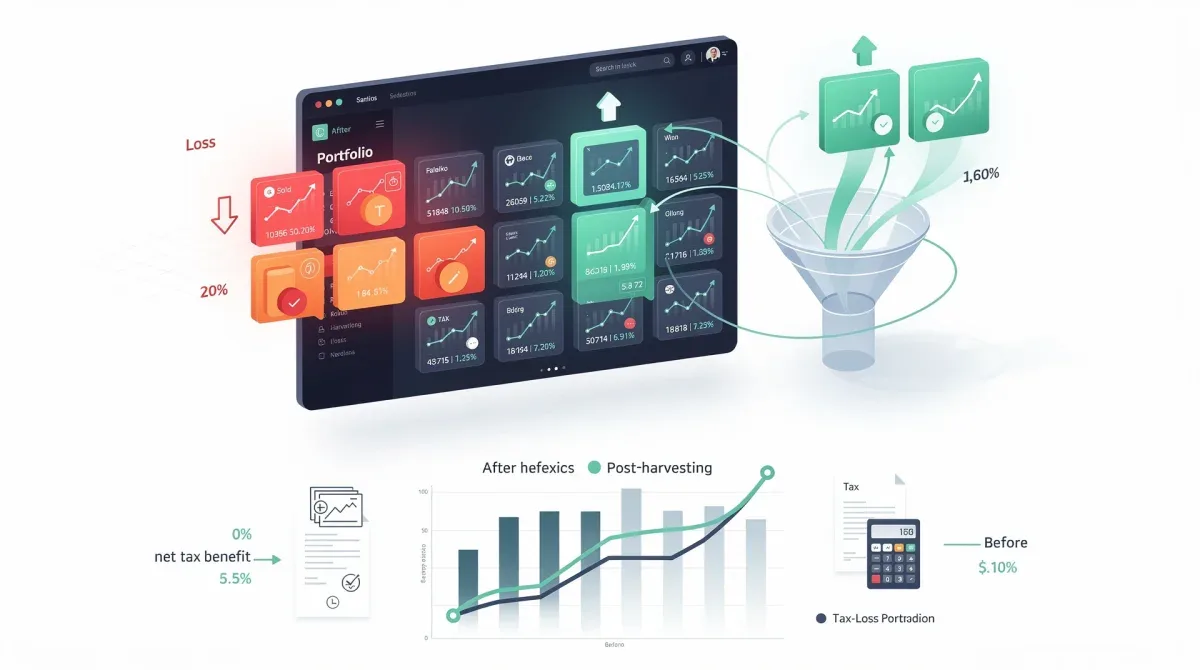
The long-term appeal of direct indexing tax-loss harvesting lies in its potential to manage taxable gains across multiple years.
Realized losses can provide flexibility when investors sell appreciated assets, rebalance portfolios, or make other taxable investment decisions.
However, the strategy should not be evaluated solely by the amount of losses harvested.
Investors must also consider the taxable gains that may arise when replacement securities or appreciated positions are eventually sold.
In some circumstances, tax deferral can still be valuable because it allows investors to retain funds that otherwise would have been paid in taxes earlier.
The size of that advantage depends on how long the tax is deferred, future tax rates, investment returns, and the timing of withdrawals or sales.
For this reason, a 1.8% annual tax alpha estimate should not automatically be compounded as though it were a guaranteed additional investment return.
Long-term after-tax results require a more complete calculation that considers fees, current and deferred taxes, portfolio performance, and the investor's eventual disposition of assets.
These factors are central to informed financial decisions.
Future Trends and Investor Adoption
Investment technology has made it easier for portfolio managers to monitor many individual securities and identify potential harvesting opportunities.
Automated systems can evaluate market movements, cost bases, tax lots, and portfolio restrictions more frequently than traditional manual processes.
This technology may help expand access to personalized indexing, although account minimums and provider fees remain important considerations.
Investors should also monitor regulatory developments that could affect tax management, capital gains, or the treatment of particular transactions.
Tax rules may change, and the value of a harvesting strategy can vary when laws or individual circumstances change.
For retirement-focused investors, direct indexing may have different implications depending on whether assets are held in taxable brokerage accounts or tax-advantaged retirement arrangements.
Tax-loss harvesting generally does not offer the same benefit inside retirement accounts where investment gains and losses are not recognized in the same manner as taxable brokerage transactions.
Understanding account location is therefore an important part of long-term financial planning.
Ultimately, personalized indexing may continue attracting investors who value customization and tax-management flexibility, but traditional ETFs remain practical options for diversified, low-cost investing.
Key Aspect | Description |
|---|---|
Tax-Loss Alpha | Some analyses estimate benefits near 1.8% under specific assumptions, but results are not guaranteed and vary by investor. |
Ownership | Direct indexing holds individual securities, while ETF investors own shares of a pooled investment fund. |
Customization | Direct indexing can support stock exclusions and personalized portfolio restrictions, with possible tracking differences. |
Tax Efficiency | Direct indexing allows security-level harvesting; ETF investors can also harvest losses at the fund-share level. |
Costs and Complexity | Direct indexing may involve higher management costs and more complex tax reporting than conventional index ETFs. |
Frequently Asked Questions About Direct Indexing Tax Harvesting
What is Direct Indexing Tax Harvesting?
Direct indexing tax-loss harvesting is a strategy that combines ownership of individual index-related securities with the selective realization of capital losses. These losses may offset capital gains or provide other permitted tax benefits. The approach offers greater control than owning a single index ETF, but its effectiveness depends on the investor's taxable circumstances, market conditions, and management costs.
How does it differ from traditional S&P 500 ETFs?
Direct indexing involves holding individual stocks intended to approximate an index, while traditional S&P 500 ETFs provide exposure through shares of a pooled fund. Direct ownership allows investors to realize losses on particular securities. ETF investors can also harvest losses by selling fund shares, but they cannot directly select individual underlying stocks for tax purposes.
What is the '1.8% in Tax-Loss Harvesting Alpha' referring to?
The 1.8% figure represents an estimate of potential annual tax-related value under particular assumptions. It is not a guaranteed investment return or a universal benefit. Actual results depend on tax rates, portfolio composition, market volatility, realized gains, fees, and future tax liabilities. Investors should distinguish immediate tax savings from taxes that may simply be deferred until a later sale.
Is Direct Indexing only for ultra-high-net-worth individuals?
No. Direct indexing was historically associated with larger investment accounts because managing numerous securities required substantial resources. Technology has helped reduce some of these barriers, and certain providers now offer services to a broader range of investors. However, account minimums, management fees, and tax circumstances still determine whether the strategy is practical for a particular household.
What are the main benefits of Direct Indexing Tax Harvesting?
The potential benefits include additional opportunities to realize capital losses, customized security selection, greater control over individual holdings, and coordination with other taxable investments. These advantages are not guaranteed to produce superior after-tax returns. Investors should compare them with the lower costs, simplicity, diversification, and existing tax efficiency of traditional S&P 500 ETFs.
What this means
Direct indexing tax-loss harvesting offers an alternative to traditional S&P 500 ETFs for investors seeking additional control over individual securities and potential tax-management opportunities.
While estimates such as 1.8% in annual tax alpha may illustrate the potential value of harvesting strategies, they should not be interpreted as guaranteed returns.
Successful implementation depends on the investor's tax profile, availability of capital gains, portfolio size, management fees, and compliance with IRS rules.
Traditional S&P 500 ETFs remain attractive for their simplicity, broad diversification, and generally low expenses, while direct indexing may be more suitable for investors with complex taxable portfolios.
Before selecting either strategy, investors should evaluate expected after-tax outcomes and consider professional guidance where appropriate. The best investment approach is one that balances costs, risk, diversification, and financial goals rather than relying on a single projected tax advantage.