High-Yield Savings vs. 6-Month CDs: 4.8% Cash Returns
Anúncios
High-Yield Savings Accounts vs. 6-Month CDs offer different opportunities for American savers seeking competitive cash returns in 2026. Understanding interest rates, liquidity, deposit insurance, and withdrawal conditions helps individuals choose appropriate savings strategies.
High-Yield Savings Accounts vs. 6-Month CDs represents an important financial decision for Americans seeking competitive returns while protecting their short-term savings.
Both options can generate interest on deposited funds, although their accessibility, rate stability, and withdrawal conditions differ in important ways.
This guide explains their advantages, potential returns, financial risks, and practical strategies for managing cash savings throughout changing economic conditions.
Navigating Today's Interest Rate Environment
Changes in federal monetary policy influence the savings products available through American banks, credit unions, and other participating financial institutions.
Anúncios
Understanding how interest rates affect personal finances helps depositors evaluate available opportunities without overlooking account restrictions or potential changes in future returns.
The High-Yield Savings Accounts vs. 6-Month CDs comparison becomes particularly relevant when consumers must balance financial flexibility against predictable interest earnings.
The Appeal of High-Yield Savings Accounts
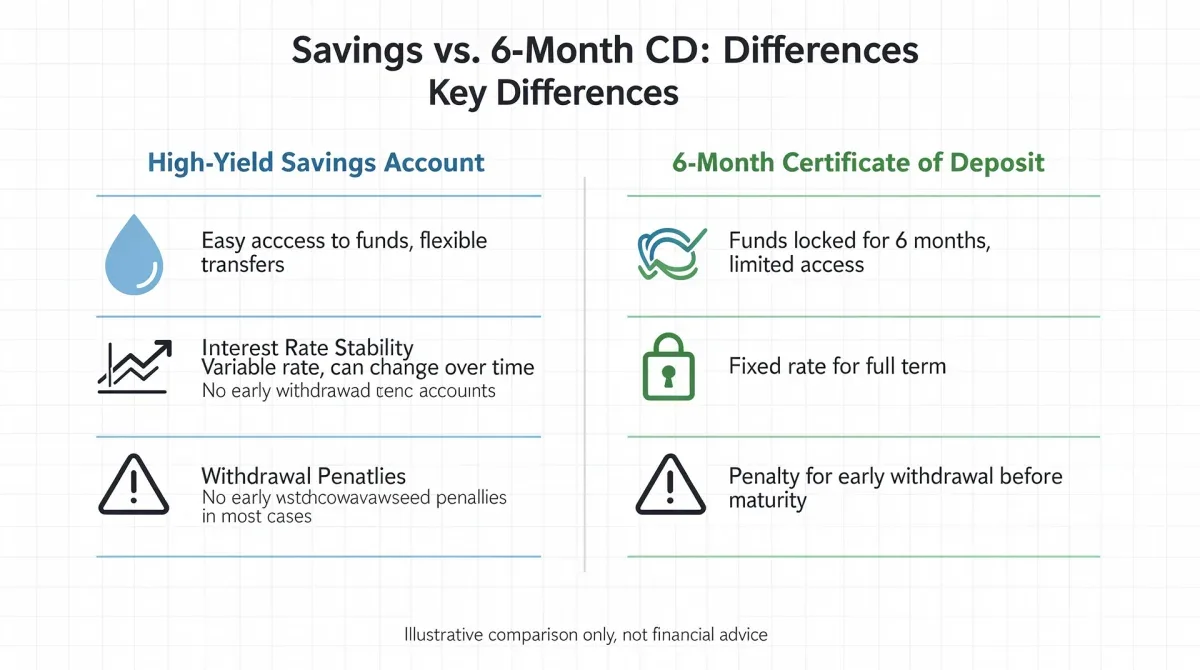
High-yield savings accounts, commonly called HYSAs, typically offer higher interest rates than many conventional savings accounts available through traditional banking institutions.
Anúncios
These accounts generally allow withdrawals without early termination penalties, although individual institutions may impose transaction restrictions, transfer delays, or administrative fees.
Their variable interest rates provide opportunities to benefit from rising yields while exposing depositors to potentially lower returns when rates decline.
Understanding 6-Month Certificates of Deposit
Traditional fixed-rate certificates of deposit allow consumers to commit funds for a predetermined period while earning interest according to an agreed rate.
A six-month CD provides a relatively short commitment period, making it suitable for funds that depositors do not expect to need immediately.
Early withdrawals may trigger financial penalties, representing an important consideration when evaluating High-Yield Savings Accounts vs. 6-Month CDs for short-term savings.
Analyzing the 4.8% Cash Returns Opportunity
An annual percentage yield of 4.8% represents an attractive hypothetical benchmark for evaluating the potential earnings associated with different savings products.
However, available rates vary between institutions, account types, deposit amounts, geographical requirements, and the promotional conditions associated with individual financial products.
Consumers comparing High-Yield Savings Accounts vs. 6-Month CDs should verify current advertised rates directly with financial institutions before committing their money.
Understanding Annual Percentage Yield
Annual percentage yield, commonly abbreviated as APY, represents an annualized interest return that incorporates applicable compounding according to the account's terms.
A six-month CD advertising 4.8% APY does not generate a complete 4.8% return during its initial six-month deposit period.
Assuming an exact half-year term and retained interest, the equivalent six-month return would be approximately 2.37% before applicable taxes or penalties.
Where to Find Competitive Savings Rates
Online banks, traditional financial institutions, and federally insured credit unions may offer competitive savings products depending on their individual deposit funding strategies.
Market comparisons published in November 2026 show that available yields differ substantially across savings accounts and certificates with different maturity periods.
Review current six-month CD rate comparisons and verify individual bank disclosures to identify offers that match your available savings and financial requirements.
Understanding Promotional Interest Rates
Some savings products advertise elevated promotional yields that apply only during introductory periods or when customers meet specified account activity requirements.
Additional conditions may involve qualifying direct deposits, minimum account balances, maximum eligible balances, or restrictions concerning new customers and deposited funds.
These requirements matter when comparing High-Yield Savings Accounts vs. 6-Month CDs because advertised returns may not apply equally to every depositor.
Calculating Potential Six-Month Cash Returns
Comparing hypothetical interest earnings can help consumers understand how different deposit amounts translate into potential financial gains over relatively short savings periods.
The following examples assume a constant 4.8% APY, an exact six-month period, retained interest, and no account fees or withdrawal penalties.
Actual High-Yield Savings Accounts vs. 6-Month CDs returns may differ because of changing savings rates, specific deposit terms, and applicable tax obligations.
Example 1: Depositing $5,000
A hypothetical deposit of $5,000 earning 4.8% APY could generate approximately $118.59 in interest over an exact six-month savings period.
The resulting account balance would reach approximately $5,118.59, assuming the original deposit remains untouched and all earned interest stays within the account.
This example illustrates how smaller cash reserves can generate additional earnings without requiring exposure to ordinary stock market price fluctuations.
Example 2: Depositing $10,000
A deposit of $10,000 earning a constant 4.8% APY could accumulate approximately $237.19 in interest over an equivalent six-month period.
The resulting balance would reach approximately $10,237.19 before applicable income taxes, account charges, or other expenses that could reduce realized returns.
When evaluating High-Yield Savings Accounts vs. 6-Month CDs, this example demonstrates how equivalent yields can produce similar earnings under comparable conditions.
Example 3: Depositing $25,000
A larger hypothetical deposit of $25,000 earning 4.8% APY could generate approximately $592.97 in interest during an exact six-month period.
The accumulated balance would reach approximately $25,592.97, assuming the applicable interest rate remains unchanged and no funds are withdrawn prematurely.
Actual savings account earnings may vary throughout the period, while a traditional fixed-rate CD provides greater certainty regarding its contracted interest rate.
Liquidity vs. Stability: Making the Right Choice
Liquidity describes how easily consumers can access their deposited money when unexpected expenses, financial obligations, or changing household circumstances require available cash.
Rate stability concerns the predictability of interest earnings throughout a particular period, especially when broader economic conditions influence market interest rates.
The central High-Yield Savings Accounts vs. 6-Month CDs distinction involves balancing immediate access to funds against greater certainty about future interest earnings.
Assessing Your Immediate Financial Needs
Before depositing money into a fixed-term account, consider upcoming expenses involving housing, healthcare, transportation, education, and other important household financial obligations.
Maintaining an accessible emergency fund can help households manage unexpected expenses without paying unnecessary withdrawal penalties or relying exclusively on borrowed money.
The appropriate amount depends on employment stability, household expenses, existing financial commitments, and individual circumstances rather than a single universal savings requirement.
When a High-Yield Savings Account Makes More Sense
A high-yield savings account may be suitable when consumers need flexibility concerning the timing or amount of future withdrawals from their savings.
These accounts can support emergency reserves, upcoming purchases, irregular household expenses, and financial goals without requiring a predetermined withdrawal date.
Within High-Yield Savings Accounts vs. 6-Month CDs, liquidity remains a particularly important advantage for households facing uncertain short-term financial requirements.
When a Six-Month CD May Be More Appropriate
A traditional six-month CD may suit consumers who already maintain accessible emergency savings and have additional cash available for temporary financial commitments.
These products can provide predictable interest earnings when the contracted fixed rate remains applicable throughout the deposit's complete maturity period.
Consumers should confirm that their anticipated financial obligations will not require early access to funds before establishing a fixed-term deposit.
The Impact of Federal Reserve Policy
The Federal Reserve influences financial conditions through monetary policy decisions that affect borrowing costs, short-term market interest rates, and deposit funding conditions.
Changes in Federal Reserve interest rate policy can influence savings yields, although individual financial institutions establish their own rates according to commercial considerations.
Understanding these relationships provides useful context for High-Yield Savings Accounts vs. 6-Month CDs without requiring depositors to predict future monetary policy decisions.
What Happens When Interest Rates Decline?
When market interest rates decline, banks may reduce the variable yields associated with their high-yield savings accounts and newly issued deposit products.
Existing traditional fixed-rate CDs generally retain their contracted interest rate until maturity, provided the applicable account terms remain satisfied.
This characteristic can make fixed-term deposits useful for consumers seeking predictable interest earnings during periods of declining market yields.
What Happens When Interest Rates Increase?
Rising market interest rates may encourage some financial institutions to increase savings account yields or introduce new CDs with more attractive terms.
However, an existing fixed-rate CD generally retains its original rate, potentially preventing depositors from immediately benefiting from newly available higher yields.
High-Yield Savings Accounts vs. 6-Month CDs therefore involves considering both the advantages and potential opportunity costs associated with locking in interest rates.
Comparing Risk and Return Profiles
Traditional insured savings accounts and certificates of deposit generally provide relatively low-risk opportunities for holding cash compared with investments involving fluctuating market prices.
However, financial safety still depends on the institution's insurance status, ownership arrangements, account terms, and whether deposits exceed applicable insurance limits.
Consumers evaluating High-Yield Savings Accounts vs. 6-Month CDs should distinguish deposit protection from guarantees concerning future purchasing power or interest earnings.
Understanding FDIC Deposit Insurance
The Federal Deposit Insurance Corporation provides standard coverage of $250,000 per depositor, per insured bank, for each applicable account ownership category.
Individual savings accounts, checking accounts, and certificates held within the same ownership category at one bank are generally combined when calculating coverage.
Opening multiple deposit products at the same insured bank does not automatically create separate insurance limits for each individual financial account.
Understanding NCUA Credit Union Coverage
Federally insured credit unions provide qualifying share insurance coverage through the National Credit Union Share Insurance Fund administered by the NCUA.
Standard individual account coverage generally reaches $250,000, subject to applicable ownership categories and the combined value of qualifying insured deposits.
Consumers should verify the insurance status of their selected credit union before depositing money into savings accounts or share certificates.
Why Inflation Still Matters
Although insured deposits protect qualifying balances against institutional failure, they do not guarantee that savings will maintain their purchasing power over time.
If inflation exceeds after-tax interest earnings, the real purchasing power of deposited funds may decline despite an increasing nominal account balance.
Understanding inflation helps consumers evaluate High-Yield Savings Accounts vs. 6-Month CDs according to broader financial objectives rather than advertised interest rates alone.
Understanding Early Withdrawal Penalties
Traditional certificates of deposit generally impose early withdrawal penalties when customers access their money before the agreed maturity date.
Penalty structures vary between financial institutions and may involve forfeiting interest equivalent to a specified number of days or months.
These conditions can significantly affect realized returns, particularly when consumers need to withdraw funds shortly after opening a fixed-term deposit.
How Withdrawal Penalties Can Affect Your Earnings
Consider a hypothetical six-month CD that charges an early withdrawal penalty equivalent to ninety days of interest under its specific account agreement.
Withdrawing the deposit shortly after opening could result in a penalty exceeding the interest accumulated during that relatively short holding period.
This possibility demonstrates why High-Yield Savings Accounts vs. 6-Month CDs comparisons should consider access restrictions alongside the advertised annual percentage yield.
Are No-Penalty CDs Worth Considering?
Some financial institutions offer no-penalty CDs that allow qualifying withdrawals without the conventional early termination charges associated with traditional fixed-term deposits.
These products may impose initial waiting periods, full-balance withdrawal requirements, or other restrictions that differ between institutions and account agreements.
Consumers should compare their available rates and withdrawal conditions before determining whether a no-penalty CD provides an appropriate balance of financial flexibility.
Practical Strategies for Managing Cash Savings
Households do not necessarily need to choose a single savings product when managing available cash reserves and different short-term financial objectives.
Combining accessible savings accounts with appropriately selected fixed-term deposits can help address different financial requirements within a broader household savings strategy.
High-Yield Savings Accounts vs. 6-Month CDs becomes a complementary financial discussion when both products serve separate purposes within the same savings plan.
Creating a Six-Month CD Ladder
A CD ladder involves dividing available savings among several certificates with different maturity dates instead of committing all available funds simultaneously.
For example, consumers could open six separate six-month CDs at monthly intervals, eventually creating a schedule of monthly certificate maturities.
This arrangement may improve periodic access to funds, although it does not eliminate withdrawal restrictions before individual certificates reach their maturity dates.
Combining Emergency Savings With Fixed-Term Deposits
Consumers may retain essential emergency reserves within an accessible high-yield savings account while allocating additional money toward appropriately timed fixed-term deposits.
This approach provides opportunities for predictable interest earnings without necessarily compromising immediate access to money needed for unexpected household expenses.
The ideal High-Yield Savings Accounts vs. 6-Month CDs allocation depends on financial responsibilities, available reserves, upcoming expenses, and individual liquidity requirements.
Practical Steps to Secure Competitive Cash Returns
Finding an appropriate savings product requires comparing current account offers, verifying deposit insurance, and carefully reviewing the conditions attached to advertised yields.
Consumers should evaluate minimum deposit requirements, account maintenance charges, withdrawal restrictions, transfer procedures, and eligibility conditions before opening new financial accounts.
These considerations help ensure that High-Yield Savings Accounts vs. 6-Month CDs decisions reflect actual financial needs rather than promotional interest rates alone.
Opening a High-Yield Savings Account
Many financial institutions allow eligible consumers to open savings accounts online by submitting required identification information and completing applicable verification procedures.
Before transferring money, confirm the institution's legitimacy, deposit insurance status, minimum balance requirements, and available methods for accessing deposited funds.
Review the initial account disclosures to understand how interest is calculated, when earnings are credited, and whether administrative restrictions may apply.
Opening a Six-Month Certificate of Deposit
When opening a certificate, confirm the applicable interest rate, annual percentage yield, minimum deposit requirement, exact maturity date, and withdrawal conditions.
Consumers should also understand whether the institution automatically renews matured certificates and how much time is available to withdraw matured funds.
These details can significantly influence the practical value of High-Yield Savings Accounts vs. 6-Month CDs when comparing different financial institution offers.
Understanding CD Maturity and Automatic Renewal
When a certificate reaches maturity, the depositor may have an opportunity to withdraw funds, reinvest the balance, or select another deposit product.
Some institutions automatically renew certificates unless customers provide alternative instructions during a specified grace period or before the applicable maturity date.
Setting reminders for these dates helps consumers avoid unintended reinvestment into certificates offering less favorable interest rates or unsuitable deposit terms.
Tax Implications of Savings Accounts and CDs
Interest earned through ordinary savings accounts and certificates of deposit generally constitutes taxable income under applicable United States federal tax requirements.
Financial institutions may issue Form 1099-INT when reportable interest meets applicable reporting thresholds, although smaller interest amounts can also remain taxable.
Consumers evaluating High-Yield Savings Accounts vs. 6-Month CDs should consider after-tax earnings alongside the gross interest amounts shown in financial advertisements.
Calculating Illustrative After-Tax Returns
A hypothetical $10,000 deposit earning 4.8% APY could generate approximately $237.19 in gross interest during an exact six-month holding period.
Assuming an illustrative federal marginal income tax rate of 22%, the resulting federal tax on that interest would be approximately $52.18.
After subtracting this hypothetical federal tax, the remaining interest would be approximately $185.01, before any applicable state or local income taxes.
Market Trends and Future Outlook
Deposit interest rates continue responding to monetary policy, inflation expectations, competition between financial institutions, and changes in broader economic conditions.
Market offers available during November 2026 illustrate that competitive yields can differ considerably according to product maturity and individual eligibility requirements.
High-Yield Savings Accounts vs. 6-Month CDs should remain an ongoing financial evaluation rather than a decision based entirely on temporary market conditions.
Long-Term Financial Planning

Short-term savings products can complement broader financial strategies involving emergency reserves, future household expenses, retirement planning, and other long-term financial objectives.
Consulting a qualified financial advisor may help consumers determine how cash reserves fit within their overall financial circumstances and individual investment strategies.
Regularly reviewing savings arrangements helps households adapt to changing financial requirements without relying exclusively on previously available deposit rates or promotional offers.
Preparing for Changing Interest Rates in 2027
Future savings yields will depend on economic developments, monetary policy decisions, institutional competition, and changing demand for different types of financial deposits.
Consumers should avoid assuming that currently advertised rates will remain available throughout 2027 or that maturing certificates will renew at equivalent yields.
Maintaining flexibility within High-Yield Savings Accounts vs. 6-Month CDs strategies can help households respond appropriately to changing economic and personal circumstances.
Key Feature | Description |
|---|---|
Interest Rate | HYSA rates are variable; 6-Month CD rates are fixed for the term. |
Liquidity | HYSAs offer easy access; CDs have penalties for early withdrawal. |
Risk Profile | Both are FDIC-insured, low-risk, but with different rate stability. |
Ideal Use | HYSA for emergency funds; CD for short-term, fixed goals. |
Frequently Asked Questions About High-Yield Savings and CDs
What is the main difference between a high-yield savings account and a six-month CD?
High-yield savings accounts generally provide flexible access to funds while offering variable interest rates. Traditional six-month CDs provide a fixed interest rate for their contracted term but generally impose penalties for early withdrawals.
Can I currently earn 4.8% APY on my savings?
Potentially, depending on the institution, account type, available promotions, and eligibility requirements. Rates change frequently, so consumers should verify current offers directly with financial institutions before depositing money.
Does a six-month CD at 4.8% APY earn 4.8% in six months?
No. APY is an annualized measurement. A deposit earning 4.8% APY would generate approximately 2.37% over an exact six-month period, assuming interest remains deposited and no fees or penalties apply.
How much would $10,000 earn in six months at 4.8% APY?
Approximately $237.19 in gross interest, assuming an exact half-year period, a constant annual percentage yield, retained interest, and no fees or withdrawals.
Is my money safe in these accounts?
Eligible deposits at FDIC-insured banks generally receive protection up to $250,000 per depositor, per insured bank, per ownership category. Federally insured credit unions provide similar qualifying share insurance protection under NCUA requirements.
Which option is better for an emergency fund?
A high-yield savings account is generally more appropriate because it provides greater flexibility when unexpected expenses arise. Traditional CDs may impose financial penalties if funds are withdrawn before maturity.
Can I open multiple six-month CDs?
Yes. Opening certificates with staggered maturity dates can create a CD ladder that provides periodic access to portions of deposited savings. Insurance limits and individual withdrawal restrictions still apply.
What happens if I withdraw money from a CD early?
Most traditional CDs impose early withdrawal penalties based on the specific account agreement. Depending on the terms and timing, the penalty may exceed the interest already earned.
Can high-yield savings account rates decrease?
Yes. High-yield savings accounts generally have variable interest rates that financial institutions may change according to market conditions and individual account terms.
Are six-month CD interest rates guaranteed?
Traditional fixed-rate CDs generally retain their contracted interest rate until maturity, provided account conditions are satisfied. However, variable-rate CDs and other specialized products may operate differently.
Do I have to pay taxes on savings account interest?
Generally, yes. Interest from ordinary savings accounts and CDs is typically subject to federal income tax. State and local tax treatment depends on individual circumstances and applicable requirements.
What happens when a six-month CD matures?
Depending on the account terms, depositors may withdraw their funds, reinvest the balance, or allow automatic renewal. Reviewing the maturity date and applicable grace period helps prevent unwanted renewal arrangements.
Are online banks safer than traditional banks?
Neither banking format is automatically safer. Consumers should verify the institution's deposit insurance status, account protections, security practices, and applicable ownership limits rather than relying exclusively on whether it operates online.
Can I combine high-yield savings accounts and six-month CDs?
Yes. Maintaining accessible emergency savings while allocating additional funds toward fixed-term deposits may provide a useful balance between financial flexibility and predictable interest earnings.
Conclusion
High-Yield Savings Accounts vs. 6-Month CDs highlights important differences in financial accessibility, interest rate stability, potential earnings, and short-term savings management.
Both products can support financial goals when consumers understand account conditions, deposit insurance protections, applicable taxes, and their individual liquidity requirements.
Comparing current offers and maintaining realistic return expectations helps American savers make informed decisions while adapting to changing economic conditions.