Optimizing HSA Allocations: Maxing $4,300 for Triple Tax Relief
Anúncios
Optimizing HSA allocations in 2026 involves understanding the $4,400 self-only contribution limit, maximizing available federal tax advantages, managing qualified medical expenses, and developing an investment strategy compatible with current and future healthcare needs.
Optimizing HSA allocations in 2026 can help eligible Americans prepare for healthcare expenses while taking advantage of federal tax deductions, tax-free investment growth, and qualified tax-free withdrawals.
With the individual contribution limit increasing to $4,400, Health Savings Accounts offer additional opportunities to incorporate healthcare savings into long-term financial planning.
This guide explains the updated contribution limits, eligibility requirements, investment strategies, tax benefits, and practical considerations associated with managing an HSA effectively.
Understanding the 2026 HSA contribution limits
The Internal Revenue Service adjusts Health Savings Account contribution limits periodically to account for inflation and other requirements established under federal tax law.
Anúncios
According to the official IRS Revenue Procedure 2025-19, the 2026 contribution limit is $4,400 for self-only coverage and $8,750 for family coverage.
Understanding these thresholds is essential when optimizing HSA allocations because contributions exceeding the applicable annual limit may result in additional federal tax obligations.
What constitutes an eligible individual?

HSA eligibility generally requires qualifying health coverage, the absence of disqualifying additional coverage, and compliance with other requirements established under federal tax law.
Anúncios
Individuals enrolled in Medicare generally cannot make new HSA contributions, and people who can be claimed as another taxpayer's dependent are generally ineligible.
Before optimizing HSA allocations, confirm that your health insurance arrangement satisfies the applicable requirements, including the expanded eligibility provisions introduced for 2026.
High-deductible health plan requirements in 2026
For 2026, qualifying high-deductible health plans generally require minimum annual deductibles of $1,700 for self-only coverage and $3,400 for family coverage.
The corresponding annual out-of-pocket maximums are $8,500 for self-only coverage and $17,000 for family coverage, excluding health insurance premiums.
However, specific statutory exceptions introduced for certain insurance plans mean that traditional deductible requirements are no longer the only pathway to HSA eligibility.
Expanded HSA eligibility in 2026
Beginning January 1, 2026, qualifying Bronze and Catastrophic health insurance plans are treated as HSA-compatible under expanded federal eligibility rules.
Certain direct primary care service arrangements also no longer automatically prevent otherwise eligible individuals from contributing to an HSA, subject to applicable requirements.
These changes create additional opportunities for optimizing HSA allocations among individuals who previously may not have qualified under traditional health insurance requirements.
Telehealth services and HSA eligibility
Federal legislation permanently allows qualifying high-deductible health plans to provide certain telehealth and remote care services before participants satisfy their annual deductibles.
This provision helps eligible individuals access qualifying remote healthcare services without automatically losing their ability to contribute to a Health Savings Account.
Individuals should still review their complete health insurance arrangements because other types of coverage may affect eligibility under the applicable federal requirements.
The triple tax advantage explained
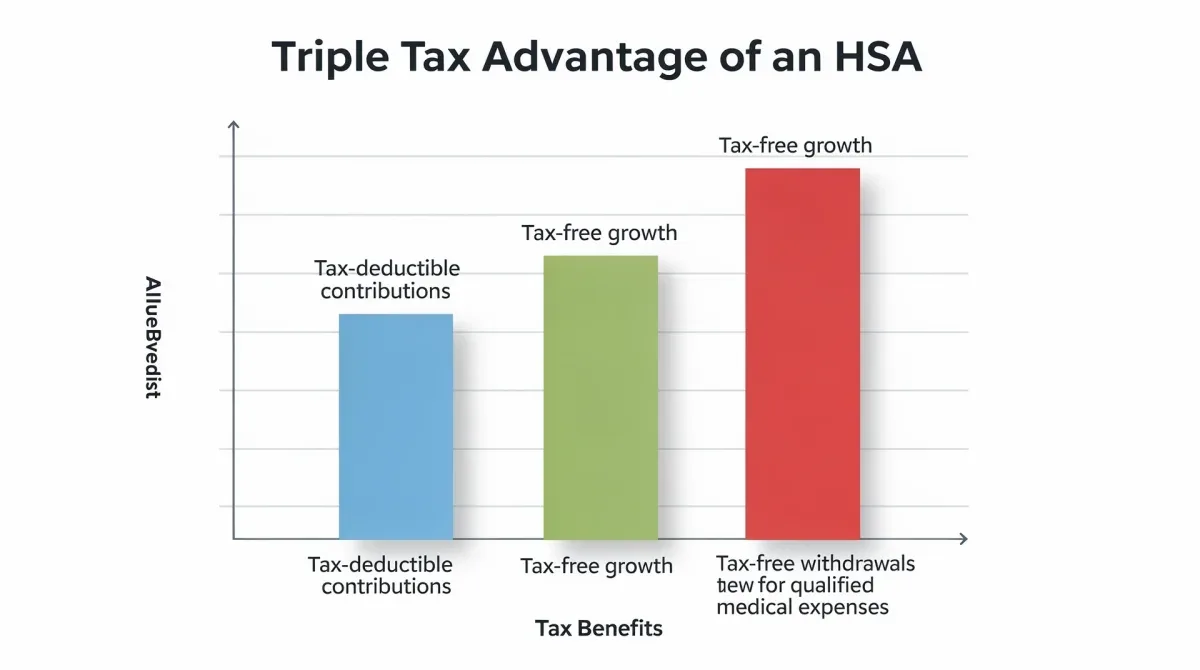
Health Savings Accounts provide three potential federal tax advantages that distinguish them from many ordinary savings accounts and other financial arrangements.
These advantages include deductible or excluded contributions, tax-free investment growth within the account, and tax-free distributions used for qualified medical expenses.
Understanding these features is central to optimizing HSA allocations and evaluating how healthcare savings can complement broader household financial objectives.
Tax-deductible contributions
Eligible personal HSA contributions may generally be deducted when calculating federal taxable income, even when the taxpayer does not itemize deductions.
Employer contributions and qualifying salary reductions through cafeteria plans are generally excluded from federal taxable income rather than claimed as separate personal deductions.
The actual tax benefit depends on contribution methods, eligibility, applicable tax rates, and the individual's overall financial and filing circumstances.
Tax-free investment growth
Interest, dividends, and investment gains accumulated within an HSA generally remain exempt from federal income taxation while the funds stay inside the account.
This feature can support long-term accumulation when account holders invest available balances in suitable financial assets offered through their HSA providers.
However, optimizing HSA allocations requires recognizing that investments can fluctuate in value, and positive returns are not guaranteed.
Tax-free withdrawals for qualified medical expenses
HSA distributions used to pay or reimburse eligible medical expenses generally qualify for federal tax-free treatment when all applicable requirements are satisfied.
Common examples include eligible physician visits, prescription medications, dental procedures, vision services, and certain over-the-counter healthcare products.
Maintaining appropriate documentation helps establish that withdrawals qualify for favorable tax treatment and prevents confusion when completing federal income tax returns.
Understanding state income tax differences
The federal tax advantages associated with HSAs do not necessarily receive identical treatment under the income tax laws of every American state.
California and New Jersey, for example, generally do not provide the same comprehensive state income tax treatment available under federal HSA rules.
When optimizing HSA allocations, consider your state's applicable tax requirements alongside the federal rules to better understand the account's actual financial advantages.
Strategies for maximizing your HSA contributions
Maximizing eligible HSA contributions requires understanding annual limits, tracking deposits, accounting for employer contributions, and maintaining sufficient resources for other household expenses.
Automatic transfers and payroll deductions can provide convenient methods for making regular contributions throughout the year without relying on occasional large deposits.
Optimizing HSA allocations also involves selecting a contribution schedule that remains compatible with current income, emergency savings, and existing financial responsibilities.
Automating regular contributions
Automatic payroll deductions or scheduled bank transfers can make it easier to contribute consistently and monitor progress toward an annual healthcare savings objective.
For an eligible individual targeting the full $4,400 contribution limit, an average monthly allocation of approximately $366.67 would reach that amount over twelve months, subject to rounding adjustments.
Adjust the contribution schedule whenever employer deposits, insurance coverage changes, or other circumstances modify the amount you are permitted to contribute.
Understanding catch-up contributions
Eligible individuals who are at least 55 years old by the end of the tax year may generally make an additional annual HSA contribution of $1,000.
For 2026, this increases the maximum contribution for a fully eligible individual with self-only coverage from $4,400 to $5,400.
Catch-up contributions can support optimizing HSA allocations among older adults preparing for future healthcare expenses, provided they remain eligible to contribute.
Leveraging employer contributions
Some employers provide HSA contributions as part of their employee benefits packages, helping workers accumulate funds for eligible healthcare expenses.
Employer deposits generally count toward the applicable annual HSA contribution limit, meaning that they must be included when calculating remaining contribution capacity.
Reviewing these arrangements regularly can help employees avoid excess contributions while incorporating available employer benefits into their healthcare savings plans.
Taking advantage of payroll contribution arrangements
Qualifying HSA salary reductions made through an employer's cafeteria plan may provide additional savings by avoiding applicable federal employment taxes.
Direct personal contributions may qualify for federal income tax deductions, but they generally do not provide the same opportunity to recover previously paid payroll taxes.
Understanding these differences can improve optimizing HSA allocations by helping eligible workers choose suitable contribution methods offered through their employers.
Practical examples of HSA contribution planning
Illustrative contribution calculations can help individuals understand how annual limits, employer deposits, and payment schedules affect their available healthcare savings opportunities.
The following examples assume full-year HSA eligibility and do not account for every possible tax situation or change in insurance coverage.
These scenarios demonstrate practical approaches to optimizing HSA allocations without implying that every household should necessarily contribute the maximum permitted amount.
Example 1: Individual contributions without employer support
Consider an eligible individual with self-only health coverage who wants to contribute the entire $4,400 maximum during the 2026 tax year.
With twelve monthly contributions, the individual would need to allocate approximately $366.67 per month, adjusting the final deposit to avoid exceeding the limit.
This schedule provides a straightforward method of distributing the annual savings target throughout the year while maintaining a predictable monthly budget.
Example 2: Contributions with employer assistance
Suppose an eligible employee receives $1,000 in annual HSA contributions from an employer and qualifies for the $4,400 self-only contribution limit.
The employee would generally have $3,400 in remaining contribution capacity, equivalent to approximately $283.33 per month over twelve months.
This example illustrates why optimizing HSA allocations requires tracking employer deposits together with personal contributions throughout the tax year.
Example 3: Maximizing family coverage contributions
An eligible household with family health coverage may contribute up to $8,750 during 2026, assuming the full annual limit applies.
If an employer contributes $1,500, the remaining contribution capacity would generally equal $7,250, or approximately $604.17 per month over twelve months.
Married individuals should also account for the rules governing shared family contribution limits and any separately eligible age-related catch-up contributions.
How much can you save in federal income taxes?
The federal income tax savings associated with deductible HSA contributions depend partly on the marginal tax rate applicable to the individual's taxable income.
Although contributions can reduce taxable income, contributing the maximum amount does not generate an identical financial benefit for every eligible taxpayer.
Evaluating hypothetical tax savings provides additional context when optimizing HSA allocations alongside other available financial planning opportunities.
Example of a taxpayer in the 22% federal tax bracket
Assume an eligible individual contributes the full $4,400 through deductible personal contributions and the entire deduction offsets income taxed at 22%.
Under these simplified assumptions, the contribution could reduce federal income tax by approximately $968, before considering other tax calculations or applicable limitations.
The potential benefit represents a reduction in tax liability rather than a guaranteed refund or an additional government payment.
Example of a taxpayer in the 24% federal tax bracket
Using the same $4,400 contribution amount, an individual whose entire deduction offsets income taxed at 24% could save approximately $1,056.
Actual tax savings may differ if the contribution affects multiple tax brackets, income-related credits, or other elements of the taxpayer's federal return.
Optimizing HSA allocations should therefore involve evaluating realistic personal tax circumstances rather than relying exclusively on generalized estimates.
Investing HSA funds for long-term growth
Many HSA providers offer investment features that allow account holders to allocate eligible balances beyond traditional interest-bearing cash accounts.
Available investment options may include mutual funds, bonds, and exchange-traded funds (ETFs), depending on the provider's investment platform and account requirements.
Optimizing HSA allocations through investments requires balancing potential long-term growth against market risks, account fees, and anticipated healthcare spending.
Choosing the right investment options
Consider your investment horizon, risk tolerance, expected medical expenses, and the costs associated with available investment products before allocating HSA funds.
Diversification may help reduce exposure to individual investments, although it cannot eliminate the possibility of losses during unfavorable financial market conditions.
Guidance from qualified financial advisors may be helpful when evaluating investment choices alongside broader retirement and healthcare savings objectives.
Understanding the power of compound growth
Compounding occurs when investment earnings remain within an account and may generate additional earnings over subsequent periods, depending on investment performance.
For illustration, a one-time $4,400 investment earning a hypothetical annual return of 5% would grow to approximately $11,675 after twenty years.
This example assumes no additional contributions, withdrawals, or fees, and does not represent a guaranteed investment outcome or predicted future return.
Balancing cash reserves and long-term investments
Maintaining a portion of your HSA balance in cash can help cover anticipated medical expenses without requiring investments to be sold unexpectedly.
Some account holders choose to invest only the portion of their healthcare savings that they do not expect to need in the near future.
This approach can support optimizing HSA allocations while reducing the likelihood of selling investments during unfavorable market conditions to cover immediate healthcare costs.
Evaluating HSA investment fees
HSA providers may charge account maintenance fees, investment administration expenses, fund expense ratios, or other costs associated with their available services.
Over extended periods, these expenses can reduce the overall investment balance and influence the financial value of maintaining a particular account.
Compare account features and complete investment costs before selecting a provider, rather than focusing exclusively on advertised tax advantages or historical returns.
Using an HSA as a retirement savings vehicle
Although HSAs are designed primarily to cover healthcare expenses, accumulated balances can remain available for qualified medical costs throughout retirement.
Unlike many traditional retirement accounts, Health Savings Accounts do not impose required minimum distributions on their original account holders during retirement.
This flexibility makes optimizing HSA allocations a potentially useful component of long-term retirement planning for individuals with sufficient current financial resources.
Using HSA funds after age 65
After reaching age 65, account holders may generally withdraw HSA funds for non-medical purposes without incurring the additional 20% federal tax.
However, nonqualified distributions remain subject to ordinary federal income taxation, meaning that these withdrawals do not receive the same treatment as qualified healthcare expenses.
Qualified medical distributions can continue receiving federal tax-free treatment after age 65, provided the applicable requirements are satisfied.
Managing Medicare enrollment and HSA contributions
Individuals generally become ineligible to make new HSA contributions beginning with the first month in which they are enrolled in Medicare.
Previously accumulated HSA funds remain available for eligible expenses, even after an individual is no longer permitted to make new contributions.
Because Medicare Part A coverage can sometimes apply retroactively, individuals approaching enrollment should carefully review contribution timing to avoid excess deposits.
Balancing current and future healthcare needs
Some account holders choose to pay current medical expenses using other available resources while leaving their HSA balances invested for future healthcare needs.
Eligible expenses incurred after the account was established may generally be reimbursed later, provided appropriate documentation is maintained and no duplicate reimbursement occurs.
This approach may support optimizing HSA allocations, but only when paying current medical expenses independently does not create unnecessary debt or financial hardship.
Navigating qualified medical expenses
Understanding which healthcare expenses qualify for tax-free reimbursement is necessary for maintaining the intended federal tax advantages associated with an HSA.
Eligible expenses generally include qualifying medical costs incurred by the account holder, their spouse, and certain dependents under applicable federal tax rules.
When optimizing HSA allocations, review eligibility requirements before withdrawing funds rather than assuming every health-related purchase qualifies automatically.
Common qualified medical expenses
Qualified healthcare expenses may include physician visits, eligible diagnostic services, prescription medications, medically necessary treatments, and various dental or vision expenses.
Eligible eye examinations, prescription eyeglasses, contact lenses, and certain dental procedures may also be reimbursed using available HSA funds.
However, expenses reimbursed through health insurance or another source cannot generally be reimbursed again using tax-free HSA distributions.
Over-the-counter medications and healthcare products
Certain over-the-counter medications qualify for HSA reimbursement without requiring a prescription, following changes introduced under federal legislation in 2020.
Eligible menstrual care products may also qualify, while the eligibility of other products depends on their intended purpose and applicable medical expense requirements.
Review the specific product and relevant federal guidelines rather than assuming that every item purchased at a pharmacy qualifies for tax-free reimbursement.
Understanding eligible insurance premiums
Health insurance premiums generally do not qualify as medical expenses for tax-free HSA reimbursement, although important statutory exceptions are available in particular circumstances.
These exceptions can include qualifying COBRA premiums, eligible long-term care insurance premiums within applicable limits, and certain premiums paid while receiving unemployment compensation.
After age 65, certain Medicare and other eligible healthcare premiums may qualify, although Medicare supplemental insurance premiums generally remain excluded.
Direct primary care expenses in 2026
Expanded HSA rules effective in 2026 allow tax-free reimbursement of periodic fees associated with certain qualifying direct primary care service arrangements.
These arrangements must satisfy applicable statutory requirements, including relevant restrictions concerning covered services and maximum permitted monthly fees.
Individuals interested in optimizing HSA allocations through direct primary care should verify that their specific arrangements satisfy the federal eligibility requirements.
Keeping accurate HSA records
Maintaining comprehensive financial records helps account holders demonstrate that their HSA contributions and distributions received appropriate tax treatment under applicable federal requirements.
Documentation becomes particularly important when individuals pay expenses independently and intend to request reimbursement from their HSA several years later.
A consistent record-keeping system supports optimizing HSA allocations while reducing administrative difficulties associated with tax preparation and potential reviews.
Organizing medical receipts and invoices
Maintain receipts, invoices, insurance explanations of benefits, payment confirmations, and other documentation that establishes the nature and amount of eligible medical expenses.
Keep records showing that the expenses were incurred after your HSA was established and were not previously reimbursed through insurance or another arrangement.
Digital storage systems can simplify document organization, provided sensitive healthcare and financial information is protected against unauthorized access.
Understanding HSA tax reporting forms
HSA account holders generally report contributions and distributions on IRS Form 8889 when completing the applicable federal individual income tax return.
Form 1099-SA provides information about distributions, while Form 5498-SA reports certain account contribution information supplied by the HSA custodian.
Review these documents alongside employer-reported contributions and personal records to help ensure that the amounts reported on your return are accurate.
Avoiding duplicate reimbursements and deductions
Medical expenses previously reimbursed through insurance, flexible spending arrangements, or other sources generally cannot be reimbursed again using tax-free HSA distributions.
Similarly, expenses claimed as itemized medical deductions cannot also be treated as eligible tax-free HSA reimbursements for those same amounts.
Optimizing HSA allocations requires maintaining clear records that distinguish reimbursed expenses, unreimbursed costs, and amounts previously used for other federal tax benefits.
HSA versus other retirement and savings accounts
Health Savings Accounts provide specialized tax advantages for healthcare expenses, while other savings and retirement accounts may support broader financial objectives.
Traditional and Roth retirement accounts have different contribution requirements, taxation arrangements, withdrawal restrictions, and eligibility considerations that should be evaluated independently.
Understanding these distinctions helps individuals incorporate optimizing HSA allocations into a diversified financial plan rather than treating one account as universally superior.
Complementing 401(k) accounts and IRAs
Employer-sponsored retirement accounts may provide valuable matching contributions, while individual retirement accounts offer additional opportunities for eligible taxpayers to accumulate retirement savings.
HSAs can complement these accounts by creating a dedicated source of funds for medical expenses that may arise before or during retirement.
The most appropriate contribution priorities depend on employer benefits, available income, debt obligations, healthcare needs, retirement objectives, and individual tax circumstances.
Understanding the differences between HSAs and FSAs
Health Savings Accounts generally allow unused balances to remain available in subsequent years, while health Flexible Spending Arrangements may impose spending deadlines and carryover restrictions.
General-purpose health FSAs can also create disqualifying coverage for HSA contribution purposes, including certain arrangements provided through a spouse's employer.
Limited-purpose or qualifying post-deductible arrangements may remain compatible, making it important to review benefits carefully before optimizing HSA allocations.
Flexibility beyond healthcare expenses
HSAs provide additional flexibility after age 65 because account holders may make non-medical withdrawals without the additional federal tax generally imposed on younger individuals.
Nevertheless, qualified medical distributions remain more tax-efficient at the federal level because eligible reimbursements are generally excluded from taxable income.
Consider maintaining available healthcare savings when appropriate rather than assuming that every non-medical retirement withdrawal provides equivalent financial benefits.
Common mistakes when contributing to an HSA
Incorrect contribution calculations, changes in insurance eligibility, undocumented withdrawals, and misunderstandings about applicable tax rules can create avoidable administrative and financial complications.
Account holders should regularly review their contributions and distributions, particularly when employers provide benefits or circumstances change during the tax year.
A careful approach to optimizing HSA allocations helps preserve available tax advantages without overlooking responsibilities associated with account ownership.
Exceeding the annual contribution limit
Excess HSA contributions may be subject to a recurring 6% federal excise tax while the excess remains in the account, depending on applicable circumstances.
Tracking deposits from employers, personal bank accounts, and other eligible contributors can help identify potential excess contributions before the tax year concludes.
If an excess occurs, contact your HSA provider and review the appropriate correction procedures and tax filing deadlines before withdrawing funds.
Ignoring changes in eligibility during the year
HSA contribution limits may be affected by changes in qualifying insurance coverage, Medicare enrollment, or other circumstances that arise during the tax year.
Individuals who are eligible for only part of the year may need to calculate a prorated contribution limit unless an applicable exception applies.
Review your eligibility regularly to ensure that optimizing HSA allocations does not result in contributions exceeding the amount permitted under federal law.
Misunderstanding the last-month rule
The last-month rule may allow certain individuals who are eligible on December 1 to contribute as though they were eligible throughout the entire year.
However, using this rule generally requires maintaining eligibility throughout a subsequent testing period, subject to specific exceptions established under federal tax law.
Failure to satisfy the testing period may result in additional taxable income and a 10% additional tax on applicable contribution amounts.
Using HSA funds for nonqualified expenses
Distributions used for nonqualified expenses are generally included in federal taxable income and may be subject to an additional 20% federal tax.
Exceptions to the additional tax generally apply after age 65, disability, or death, although ordinary income tax treatment may still be relevant.
Before withdrawing funds, verify the expense's eligibility and consider whether another available source of money would be more financially appropriate.
HSA contribution deadlines for the 2026 tax year
Eligible individuals generally have until the original federal income tax filing deadline to make personal HSA contributions designated for the preceding tax year.
For the 2026 tax year, this generally means April 15, 2027, subject to any applicable filing deadline adjustments or official IRS relief.
Understanding the contribution deadline provides additional flexibility when optimizing HSA allocations during annual tax preparation and financial planning.
Designating contributions for the correct tax year
Contributions made during the early months of 2027 may qualify as either prior-year or current-year deposits, depending on their designated tax year.
Ensure that your HSA custodian records each contribution correctly, particularly when making deposits before the deadline for the preceding calendar year.
Incorrect tax-year designations can create reporting discrepancies or contribute to exceeding the annual limit applicable to a particular period.
Reviewing remaining contribution capacity
Before making final contributions, calculate the total amount already deposited into your HSA and account for any employer contributions received.
Compare this amount with the applicable annual limit, considering your eligibility, insurance coverage category, and potential catch-up contribution allowance.
This final review supports optimizing HSA allocations while reducing the likelihood of unnecessary excess contributions or incorrect tax reporting.
Future outlook and policy considerations
Healthcare financing and federal tax legislation continue evolving, creating potential changes in the eligibility requirements and financial characteristics associated with Health Savings Accounts.
Annual inflation adjustments may affect future contribution limits, while legislative decisions can modify eligible insurance arrangements and qualified healthcare expense requirements.
Staying informed through official federal resources is important when optimizing HSA allocations across several tax years and changing personal circumstances.
Recent legislative changes affecting HSAs
Federal legislative changes enacted in 2025 expanded certain HSA eligibility provisions and clarified the treatment of telehealth and specific medical service arrangements.
Several of these provisions became effective in 2026, including expanded compatibility for qualifying Bronze and Catastrophic insurance plans.
Individuals should distinguish enacted regulations from proposed future changes and verify whether their particular insurance arrangements qualify under the updated requirements.
The role of HSAs in healthcare affordability
Health Savings Accounts can help eligible households reserve money for medical expenses while potentially reducing the federal tax costs associated with healthcare savings.
However, high-deductible insurance arrangements may expose participants to substantial initial expenses, particularly when existing account balances are insufficient to cover required healthcare costs.
Optimizing HSA allocations should therefore involve evaluating insurance premiums, deductibles, available savings, and anticipated medical requirements as part of an overall healthcare budget.
Summary of HSA benefits and contribution limits
Health Savings Accounts combine healthcare savings opportunities with federal tax advantages that may support both immediate medical spending and longer-term financial planning.
Understanding eligibility rules, contribution limits, qualified expenses, and investment risks can help individuals make informed decisions concerning their healthcare savings arrangements.
The following table summarizes the principal requirements, updated 2026 contribution limits, and practical considerations associated with optimizing HSA allocations.
Key Benefit or Requirement | Description |
|---|---|
2026 Self-Only Contribution Limit | $4,400 for fully eligible individuals with qualifying self-only coverage. |
2026 Family Contribution Limit | $8,750 for eligible individuals with qualifying family coverage, subject to applicable sharing rules. |
Catch-Up Contributions | An additional $1,000 for eligible individuals aged 55 or older. |
Self-Only Limit With Catch-Up | $5,400 for fully eligible individuals who qualify for the additional contribution. |
Tax-Deductible Contributions | Eligible personal contributions may reduce federal taxable income. |
Tax-Free Growth | Account earnings generally accumulate without federal income taxation while remaining inside the HSA. |
Tax-Free Withdrawals | Eligible distributions used for qualified medical expenses generally receive federal tax-free treatment. |
Retirement Flexibility | Non-medical withdrawals after age 65 are generally taxable but exempt from the additional 20% federal tax. |
Employer Contributions | Generally count toward the applicable annual contribution limit. |
Expanded Eligibility | Qualifying Bronze, Catastrophic, and certain direct primary care arrangements receive expanded treatment under 2026 rules. |
Minimum HDHP Deductible | Generally $1,700 for self-only coverage and $3,400 for family coverage. |
Maximum HDHP Out-of-Pocket Expenses | Generally $8,500 for self-only coverage and $17,000 for family coverage, excluding premiums. |
Unused Account Balances | Remain available in subsequent years without a general annual spending deadline. |
Contribution Deadline | Generally April 15, 2027, for contributions designated for the 2026 tax year. |
Tax Reporting | HSA contributions and distributions are generally reported using IRS Form 8889. |
Frequently Asked Questions About HSAs
What is the HSA self-only contribution limit for 2026?
The official 2026 contribution limit is $4,400 for self-only coverage. The previous $4,300 limit applied to the 2025 calendar year.
Who is eligible to contribute to an HSA?
Individuals generally need qualifying health coverage, no disqualifying additional coverage, no Medicare enrollment, and must not be eligible to be claimed as another taxpayer's dependent.
What are the three main tax benefits of an HSA?
HSAs provide potential federal tax advantages through deductible or excluded contributions, tax-free growth within the account, and tax-free withdrawals for qualified medical expenses.
Can HSA funds be invested?
Yes. Many providers offer investments such as mutual funds and ETFs, although available options, minimum balance requirements, investment risks, and fees differ between accounts.
How can an HSA be used in retirement?
Qualified medical expenses can generally be reimbursed tax-free. After age 65, non-medical withdrawals are generally taxable but no longer subject to the additional 20% federal tax.
What is the HSA family contribution limit for 2026?
The annual family coverage contribution limit is $8,750, assuming full-year eligibility. Employer deposits and other applicable contributions generally count toward this amount.
Can individuals aged 55 or older contribute more?
Yes. Eligible individuals aged 55 or older can generally contribute an additional $1,000, increasing the 2026 self-only contribution limit to $5,400.
How much should I contribute monthly to maximize my HSA in 2026?
Without employer contributions, a fully eligible individual would need to contribute approximately $366.67 monthly toward the $4,400 annual maximum, with an adjustment for rounding.
Do employer HSA contributions count toward the annual limit?
Yes. Employer contributions generally count toward the applicable annual HSA limit and must be included when calculating how much additional money you can personally contribute.
What does optimizing HSA allocations mean?
It means coordinating contributions, investment decisions, cash reserves, qualified medical expenses, and available tax advantages according to individual healthcare needs and financial objectives.
Can I contribute to an HSA after enrolling in Medicare?
Generally, no. Medicare enrollment makes an individual ineligible to make new contributions for the applicable months, although previously accumulated funds remain available for eligible expenses.
Do unused HSA funds expire at the end of the year?
No. Unlike certain flexible spending arrangements, unused HSA balances generally carry forward indefinitely and remain available for future healthcare expenses.
Can I reimburse medical expenses several years later?
Generally, yes. The expenses must have been incurred after the HSA was established, remain previously unreimbursed, and satisfy applicable documentation and tax requirements.
Can I purchase over-the-counter medications with HSA funds?
Eligible over-the-counter medications generally qualify for reimbursement without a prescription. Other healthcare products must satisfy the applicable qualified medical expense requirements.
Are Bronze health insurance plans HSA-compatible in 2026?
Qualifying Bronze and Catastrophic plans are treated as HSA-compatible beginning in 2026. Individuals must still satisfy other applicable HSA contribution eligibility requirements.
What happens if I contribute more than the annual HSA limit?
Excess contributions may result in a recurring 6% federal excise tax unless corrected according to applicable procedures. Contact your HSA provider if you identify excess deposits.
Are HSA withdrawals completely tax-free?
Only qualified distributions satisfying applicable requirements receive federal tax-free treatment. Nonqualified withdrawals generally create taxable income and may trigger an additional federal tax.
Do HSAs have required minimum distributions?
No. Original HSA account holders generally are not required to withdraw a specific amount at a certain retirement age.
What is the deadline for making 2026 HSA contributions?
The deadline generally corresponds to April 15, 2027, subject to applicable deadline adjustments. Contributions must be properly designated for the 2026 tax year.
Should everyone maximize their HSA contributions?
Not necessarily. Contribution decisions should consider eligibility, household expenses, emergency savings, existing debts, employer benefits, healthcare needs, and other financial priorities.
Conclusion: Optimizing HSA allocations in 2026
Optimizing HSA allocations in 2026 offers eligible individuals opportunities to prepare for healthcare expenses while benefiting from the updated $4,400 self-only contribution limit.
Understanding federal tax advantages, expanded eligibility requirements, qualified medical expenses, and investment considerations can help account holders develop more appropriate long-term healthcare savings strategies.
By maintaining accurate records, monitoring annual contributions, and selecting suitable financial arrangements, individuals can incorporate HSAs into a balanced approach to healthcare and retirement planning.